
You are using an out of date browser. It may not display this or other websites correctly.
You should upgrade or use an alternative browser.
You should upgrade or use an alternative browser.

Longboard
Participant
- Pronouns
- He/Him
The Hexastalian Horse Racing Authority (Folyan: Hexsztaliai Lóverseny Hatóság, HLH) is the governing body of horse racing in Hexastalia, responsible for flat races, steeplechasing, and harness racing. Its functions include race planning, disciplinary procedures, protecting the sport’s integrity, licensing and registering race participants, setting and enforcing standards for race participants, setting and enforcing standards for racing venues, ensuring the welfare of both horses and their staff, promoting the sport, recruiting and training new staff in the sport, and grading races.
Hexastalia currently has 36 major racecourses licensed by HLH. It is responsible for the governance of 320 events per year. Flat racing is most popular, with 155 HLH administered races every year: 14 Grade 1 races, 15 Grade 2 races, 45 Grade 3 races, and 81 Listed (below G3) races. Steeplechase sees 100 events administered by HLH every year, followed by Harness Racing with 50 and Endurance Racing with 15.
Hexastalia currently has 36 major racecourses licensed by HLH. It is responsible for the governance of 320 events per year. Flat racing is most popular, with 155 HLH administered races every year: 14 Grade 1 races, 15 Grade 2 races, 45 Grade 3 races, and 81 Listed (below G3) races. Steeplechase sees 100 events administered by HLH every year, followed by Harness Racing with 50 and Endurance Racing with 15.
Longboard
Participant
- Pronouns
- He/Him
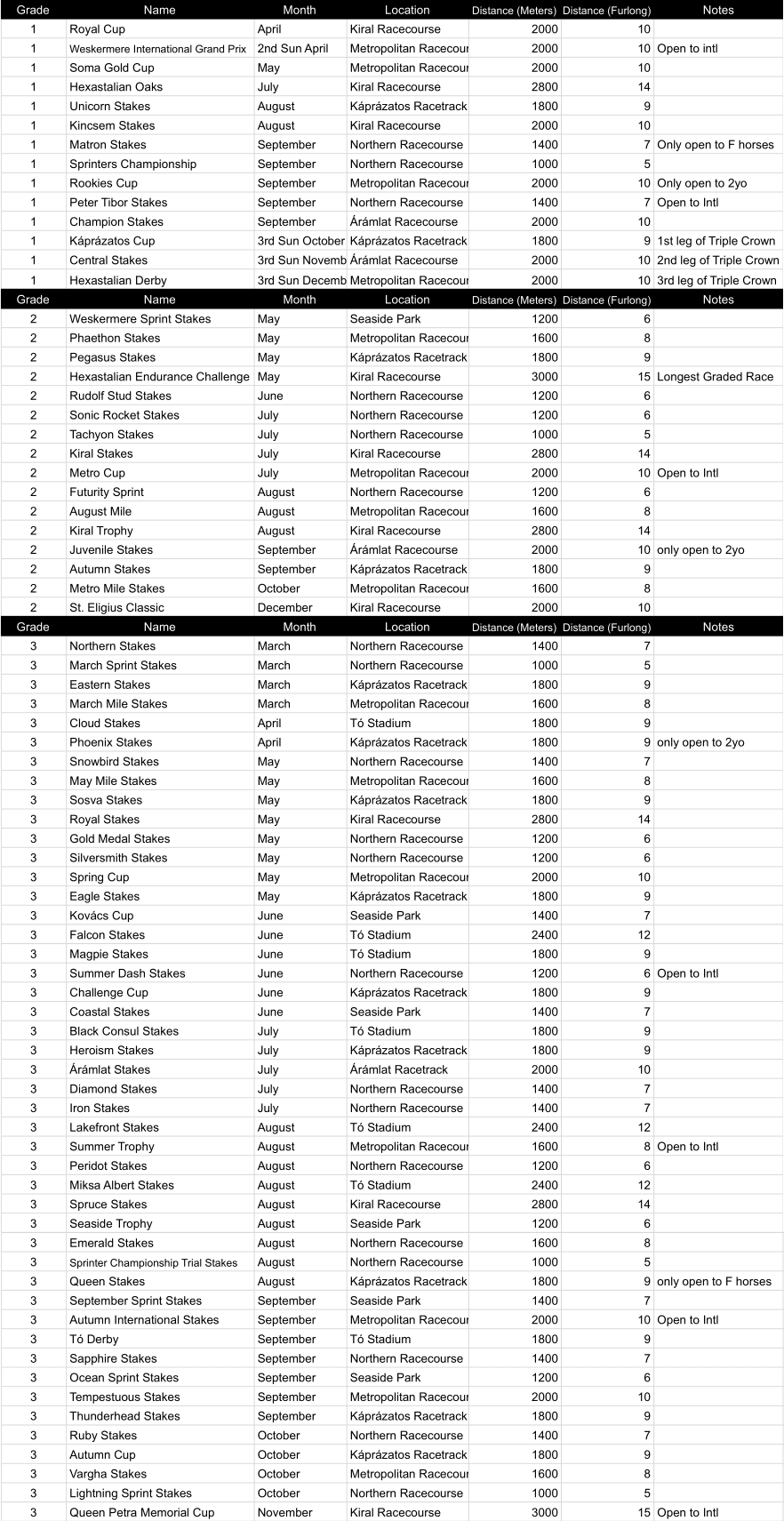
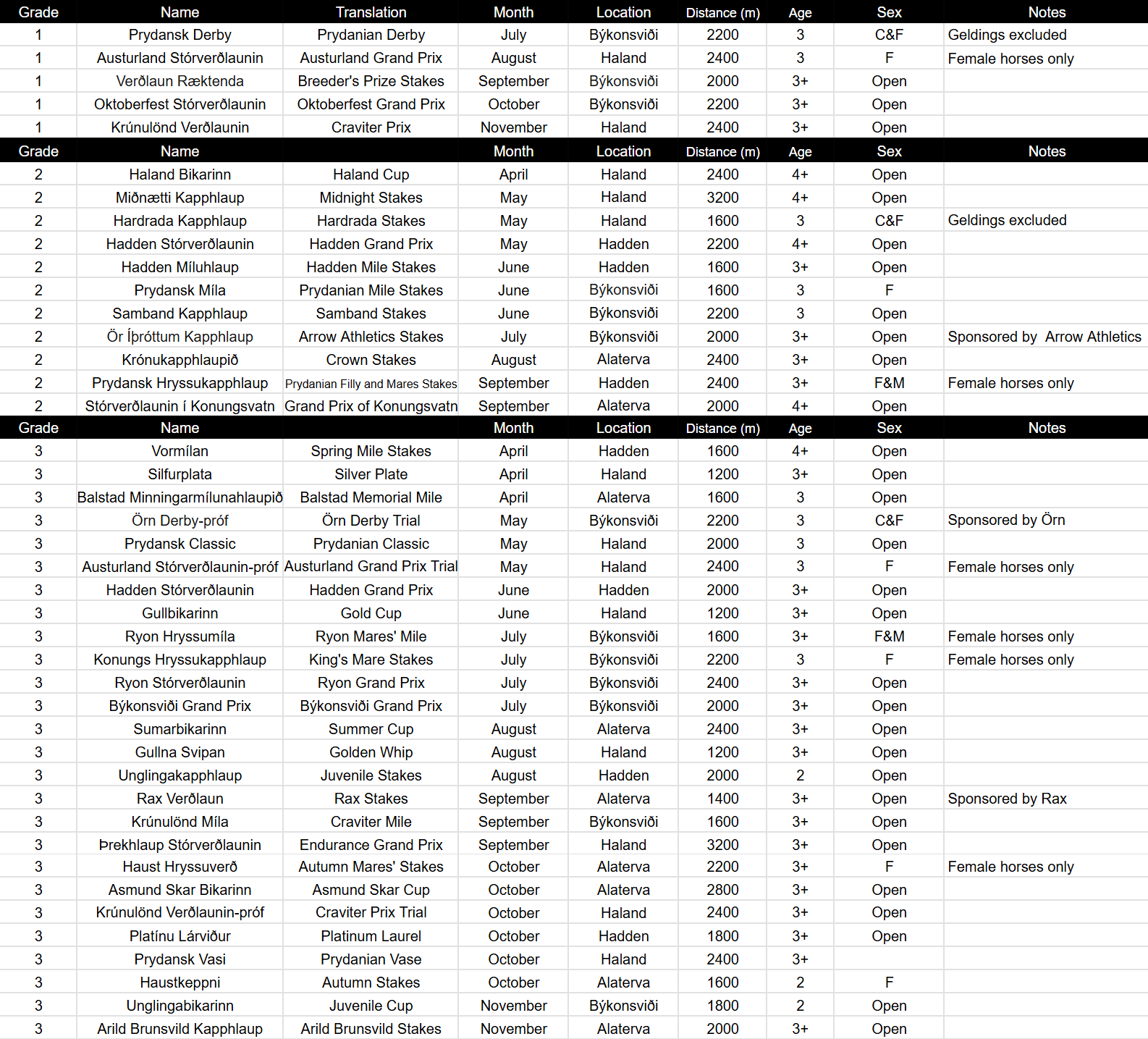
Here's a spreadsheet for all of Hexastalia's graded races. If I added the listed races, I would have to name 81 more events and 24 more racing venues, and honestly, I think I'm good.
The Hexastalian Triple Crown of Thoroughbred Racing is the highest achievement in Hexastalia's horse racing scene. It consists of winning the Káprázatos Cup, Central Stakes, and Hexastalian Derby back to back to back. These races are all Grade 1 events, the highest possible ranking in Hexastalia. They are only open to Hexastalian horses that are three years of age. The last winner of the Triple Crown was Tempestuous in 2018.
The Hexastalian Triple Crown of Thoroughbred Racing is the highest achievement in Hexastalia's horse racing scene. It consists of winning the Káprázatos Cup, Central Stakes, and Hexastalian Derby back to back to back. These races are all Grade 1 events, the highest possible ranking in Hexastalia. They are only open to Hexastalian horses that are three years of age. The last winner of the Triple Crown was Tempestuous in 2018.
Last edited:
Longboard
Participant
- Pronouns
- He/Him
The Hexastalian Triple Crown of Thoroughbred Racing is a series of three horse races consisting of the Káprázatos Cup, Central Stakes, and Hexastalian Derby. To achieve the crown, one must win all three races. These races are open only to Hexastalian horses of three years of age*, who have either earned a placement through participation in qualifying races or meet the standards of quality and are willing to pay the entry fees. Female horses (fillies) were barred from participation before 2013; despite their participation in the races now, they are still a rare sight. Between the Triple Crown's foundation in 1899 and its 1962 running, the Royal Cup was run as the October leg of the series. It was replaced by the Káprázatos Stakes -subsequently renamed the Káprázatos Cup- in the 1963 edition. In total, nine horses have won all three races of the Triple Crown. Their names and years of achievement are as follows:
•Nagy Császár, 1900
•Horizont, 1922
•Kerekasztal, 1934
•Feketerigó,1961
•Nagy Gondviselés, 1966
•Star Dancer, 1974
•Cicero Neptunus, 1996
•Tempestuous, 2018
•Winter Gale, 2025
*In thoroughbreds, all horses are treated as if they were born on January 1st of their birth year.
•Nagy Császár, 1900
•Horizont, 1922
•Kerekasztal, 1934
•Feketerigó,1961
•Nagy Gondviselés, 1966
•Star Dancer, 1974
•Cicero Neptunus, 1996
•Tempestuous, 2018
•Winter Gale, 2025
*In thoroughbreds, all horses are treated as if they were born on January 1st of their birth year.
Last edited:
Longboard
Participant
- Pronouns
- He/Him
The HLH Awards are an annual series of awards given out to outstanding people and horses in the Hexastalian Horse Racing world. Originally started in 1978, the HLH Awards offer a small amount of prize money, a trophy, and bragging rights to their winners. Award winners are decided via a public vote held between January 1 and February 1, with the awards being given out on February 14. The most prestigious award is the HLH Horse of the Year.
Current Awards:
Current Awards:
- HLH Horse of the Year
- HLH Best Two-Year-Old Colt
- HLH Best Two-Year-Old Filly
- HLH Best Three-Year-Old Colt
- HLH Best Three-Year-Old Filly
- HLH Best Older Male Horse
- HLH Best Older Female Horse
- HLH Best Sprinter
- HLH Leading Sire
- HLH Best Steeplechase Horse
- HLH Best Harness Racing Horse
- HLH Jockey of the Year
- HLH Best Steeplechase Jockey
- HLH Trainer of the Year

Alsatian Island
TNPer
- Pronouns
- he/his
- TNP Nation
- Alsatian Island
Major horse races in the Commonwealth of Great Sutherland
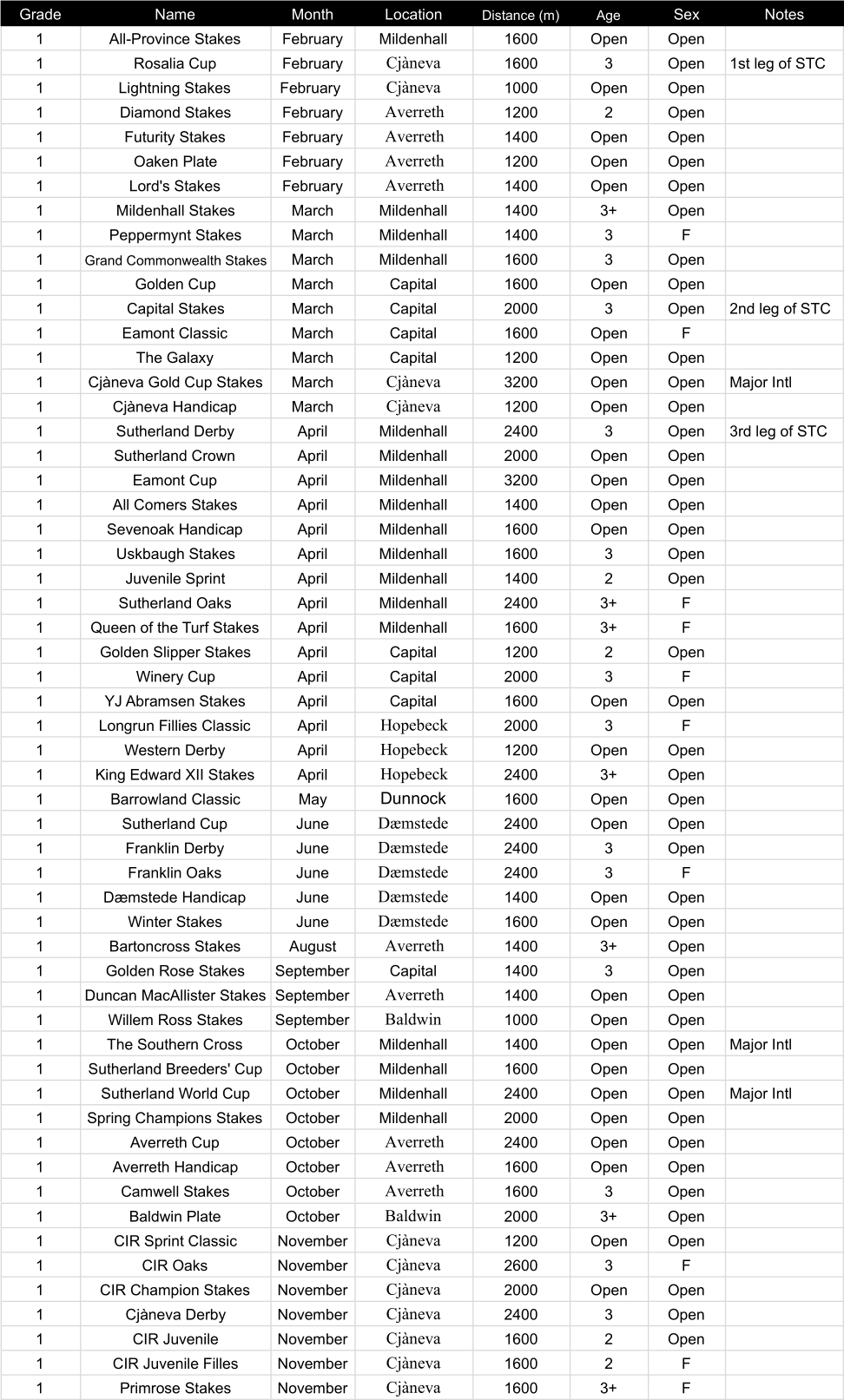
There are fifty-six grade one (Gryþ An) horse racing events in the Commonwealth of Great Sutherland at present; amongst the most prestigious are the Grand Commonwealth, Capital Stakes, and Lord's. The province of Davenshire, primarily around Mildenhall, hosts the plurality (17) of these events, including the most prominent ones in the country, while a number of other major cities such as Cjanèva, Dunnock, Dæmstede, Averreþ, Baldwin and Hopebeck host the remainder. There is a disproportionate following amongst working-class populations in the southern industrial regions, with Westmorland known for the Duncan MacAllister and Bartoncross, while some areas in the east like Franklin have comparatively little followership for horseracing.
Sutherland also hosts a number of international horseracing events, such as the Southern Cross, and the Sutherland World Cup.
Longboard
Participant
- Pronouns
- He/Him
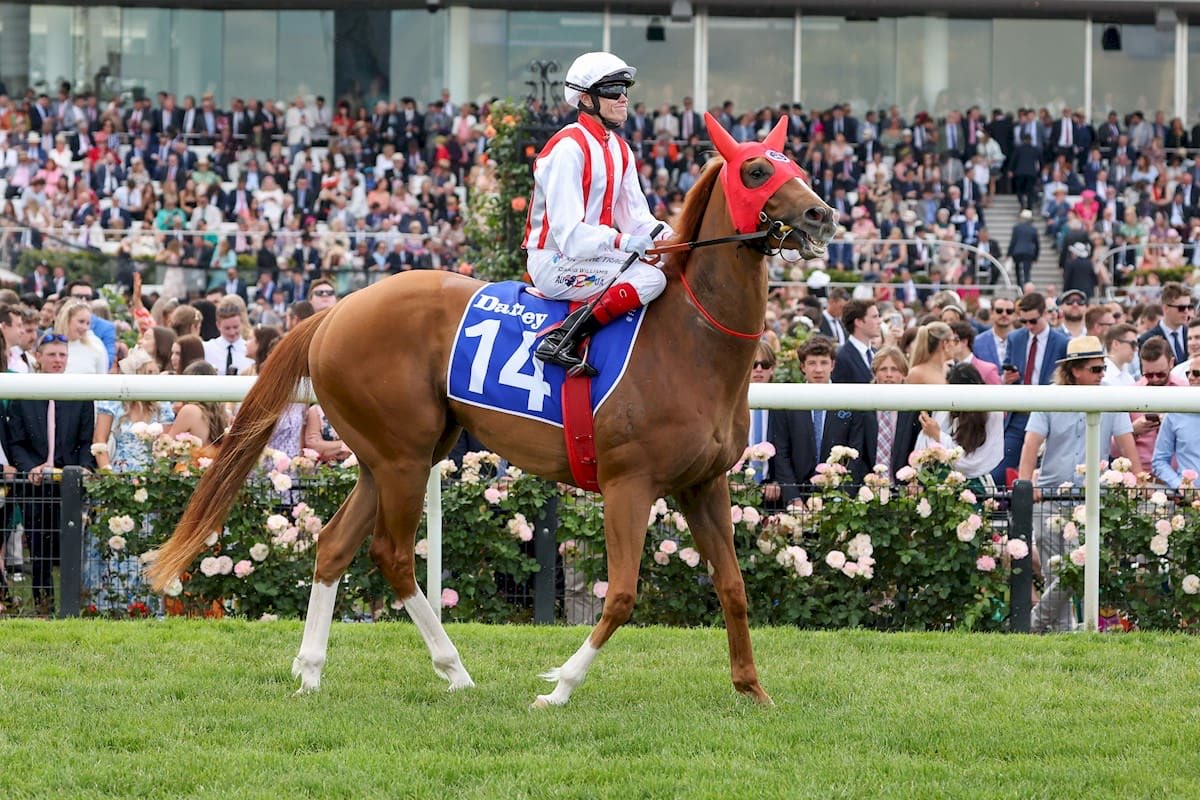
Mimosa Dream made his racecourse debut in a 1200-meter maiden race at Northern Racecourse on 26 August 2017. Ridden by Stephen Dobos and despite a slow start, Mimosa Dream closed steadily with the leaders and finished with a comfortable half-length lead. This was followed by a win in the 1200-meter Listed grade Beginners’ Luck Stakes that October at Diósgyőr Fairgrounds, beating a field of sixteen that included several other promising sprinters. This was followed by a step up in length at a 1200-meter Allowance race at Northern Racecourse that November, finishing second two lengths behind the winner, Terra Aroma.
Mimosa Dream started his 2018 campaign with a run in the G3 Northern Stakes, winning by three lengths against a field of fifteen - including Terra Aroma, who placed sixth. This was followed by wins at the G2 Weskermere Sprint Stakes and Listed grade Royal Derby. All of this was preparation for the Peter Tibor Stakes: a Grade 1 1400-meter race in September.
Mimosa Dream started the Peter Tibor Stakes as the third favorite behind the 2017 winner Shuttlecraft and Tachyon Stakes winner Top Prestige. Mimosa Dream started well but settled into the middle of the pack as Fast Ash set the pace. Top Prestige took the lead in the final straight, but Mimosa Dream spurted strongly and pulled away to win by a half-length.
Mimosa Dream’s win at the Peter Tibor Stakes motivated his connections to enter him in the Southern Cross in Sutherland. No Hexastalian horse had won the Southern Cross. He shipped out to Sutherland a week after winning the Peter Tibor Stakes. He started at fifth favorite and as one of two Hexastalian horses sent to compete. Mimosa Dream broke quickly from an inside post and vied for an early lead. Settling into second, Mimosa Dream swung wide on the turn. Accelerating wildly in the straight, Mimosa Dream crossed the finish a full length ahead of second place. He registered a speed score of 115 and was rated as the best sprinter in Hexastalia.
Following his HLH Award for Best Sprinter-winning performance the previous year, Mimosa Dream started his 2019 campaign by being moved up in length to compete in the March Mile Stakes. Despite hopes he would have gained staying power with age, this did not appear to have occurred, and Mimosa Dream finished fifth. He returned to the winner’s circle in May at the Weskermere Sprint Stakes.
It was decided that Mimosa Dream would aim for the Sprinters Championship in 2019. Consequently, he next raced in the Sprinters Championship Trial Stakes. In a close race, Mimosa Dream barely secured a berth at the Championship by a neck. Though they were hesitant about his odds of winning, his connections entered him into the Sprinters Championship. Starting as the favorite to win, Mimosa Dream was unable to keep up with the monstrous pace set by Rice Biscuit, finishing in sixth place.
Retiring to the farm to rest over the winter, Mimosa Dream’s 2020 campaign was cut short following an early win at the Northern Stakes. Shortly after the race, it was announced that Mimosa Dream had sustained injuries that required him to retire early. He was sent to Dream Farm to stud in May. He has sired four graded stakes winners since 2020.
Longboard
Participant
- Pronouns
- He/Him
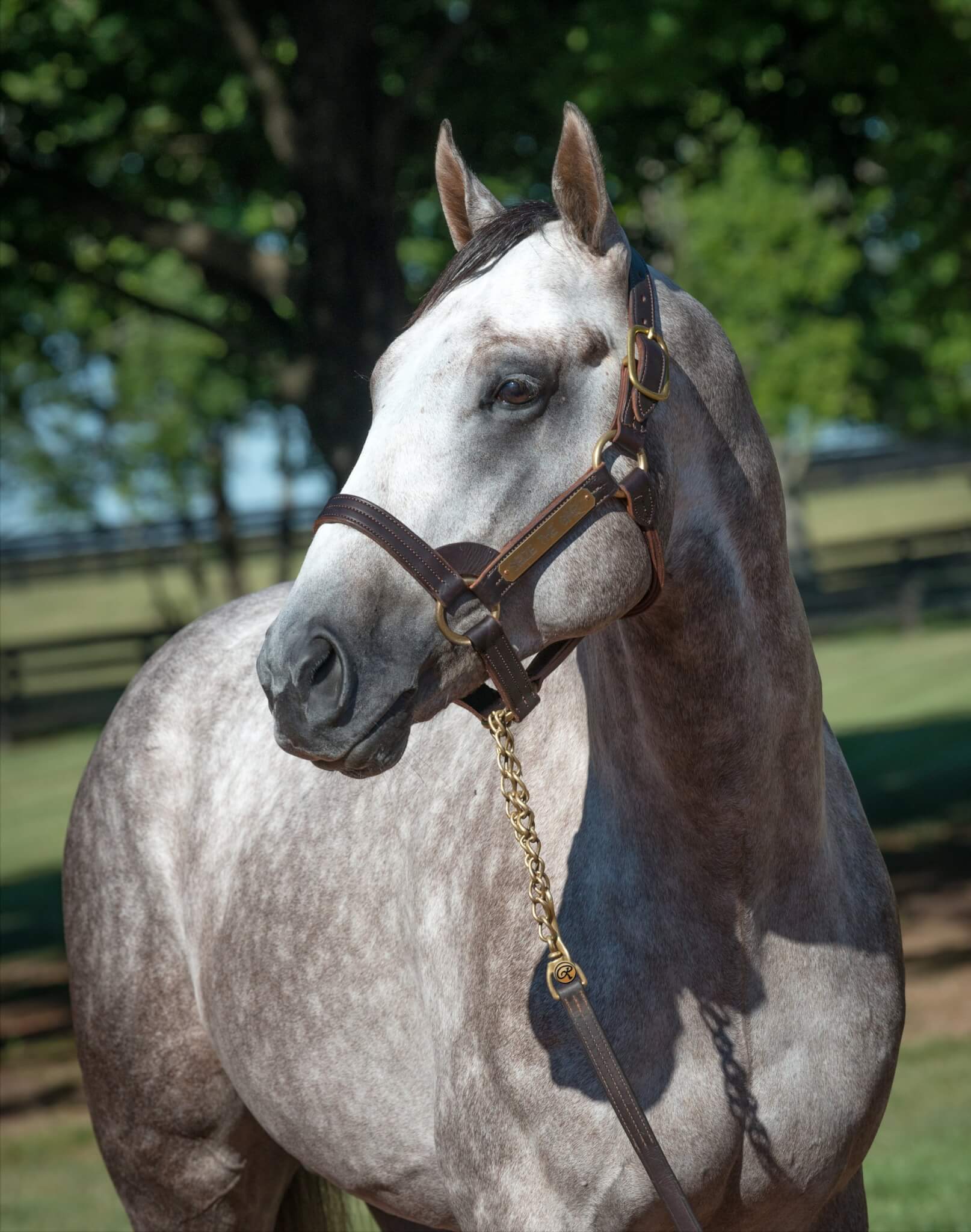
Winter Gale made his racecourse debut in a maiden race at Metropolitan Racecourse against a field of nine unraced juveniles on February 26th. Following his maiden win, he was entered into the listed grade Capital Newcomers Stakes over 2000 meters at Metropolitan Racecourse on March 15th, 2024, and won by two lengths. On April 22, Winter Gale was stepped up to compete in the Grade 3 Phoenix Stakes, placing first by a neck. He was again stepped up on September 22 to compete in the Grade 1 Junior Cup, which his sire Tempestuous had won in 2017. Winter Gale defended the family legacy by surging in the final straight and placing first by a length. His performance and undefeated two-year-old season saw him named the HLH's Best Two-Year-Old Colt.
Winter Gale made his three-year debut at the 2025 Pegasus Stakes, a G2 over 1800 meters at Káprázatos Racetrack on May 11. In his first start against an open age bracket, Winter Gale found the final furlongs wide open and cruised to a 3/4th length finish over fellow three-year-old Avalonian. In June, Winter Gale found his first loss at the 50th anniversary G3 Challenge Cup, placing second out of sixteen competitors, beaten by seventh-favorite outsider Flash Step in the home stretch. Returning to the track on August 17, Winter Gale saddled up for his first open age G1 race, the Unicorn Stakes. Racing cleanly put of the gate and through the turn, Winter Gale failed to find their usual speed in the homestretch and placed third behind Bear Witness and Regalia.
To close out his 2025 campaign, Winter Gale entered into the three races of the Hexastalian Triple Crown. At the Káprázatos Cup, Winter Gale beat out a strong field of contenders by a half-length. The Central Stakes saw Flash Step return to compete against Winter Gale, who redeemed himself with a win by a neck over Avalonian. The Hexastalian Derby saw Winter Gale add his final jewel to his crown with a win by over a length. Winter Gale’s Triple Crown achievement marks the first time a Triple Crown champion’s offspring has won the Triple Crown. It is also the first time a jockey, Miklós Kocsis, has won the Triple Crown twice.
Winter Gale’s connections have confirmed he will return to the racecourse in 2026.
Flash Step (foaled: March 25, 2022) is a Hexastalian thoroughbred racehorse, best known for an upset victory over Winter Gale in the 2025 Challenge Cup.
Flash Step is a dark bay horse with prominent white facial markings. He is notable for his small size, standing at 15.6 hands at maturity. He is a son of Flash of Genius, winner of the 2007 Autumn Stakes and 2008 Spring Cup. His dam, Step Lightly, a daughter of Lightship, won two Listed races. Flash Step’s pedigree means he is a half-second cousin of Winter Gale; they share the same great-grandfather. Flash Step was bred by Plébánia-Domb Farm and sold as a yearling at the Káprázatos Thoroughbred Sale for 23,000HD (3,407 IBU) to a local businessman, Rafael Lovász. Lovász sent his horse to train with Alexander Pusztai.
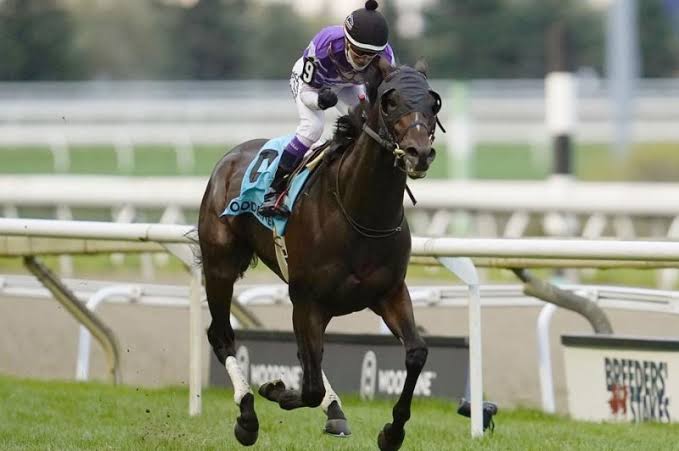
Flash Step participated in his first race of 2025 and first graded race on March 16 in the Eastern Stakes, an 1800 meter race at Káprázatos Racetrack. He finished first by a head despite being fifth favorite to win out of fourteen racers. This was both his and Robert Kis’ first graded win. Flash Step then competed in the Diósgyőr Castle Stakes, a Listed 2000 meter race at the Diósgyőr Fairgrounds; he finished outside of the money in sixth place.
On June 29th, Flash Step entered the starting gate at Káprázatos Racetrack as the seventh favorite to win the 2025 Challenge Cup. Favorite to win was future Triple Crown winner Winter Gale, coming off a 5-win streak, including 3 graded races. Flash Step showed surprising speed and acceleration in the late race, passing Winter Gale and winning by 3/4 lengths. Flash Step set a record for the fastest time to run the last furlong of the Challenge Cup, doing so without Kis needing to use his whip. Kis commented, “I was just along for the ride at the end. I think he wanted to win.”
In August, Flash Step ran in the Csalogány Stakes, a Listed undercard for the Kincsem Stakes. Despite being the favorite to win, he placed fifth out of 14 racers. This was followed by a return to Káprázatos for his first G2 race: the Autumn Stakes. Running against 2025 Soma Gold Cup runner up Cicero Viridis, Flash Step once again failed to replicate his earlier success against a G1-level horse, finishing second by a half-length.
Flash Step was once again stepped up in grade to race in the G1 Central Stakes in November. Starting as eighth favorite, Flash Step would once again face Winter Gale on the racecourse. Following a strong start, Flash Step settled into a position near the rear of the pack along the fence. At the fourth corner, Flash Step’s strong late race performance once again shined, as Kis rode him from tenth place to a third place finish in Flash Step’s first G1 race.
Flash Step is presently at pasture for the winter and will return to racing in Spring 2026
Last edited:
Longboard
Participant
- Pronouns
- He/Him
Black Consul (May 10, 1989-October 17, 1993) was a Hexastalian thoroughbred racehorse. He is best known for winning the 1992 Hexastalian Derby and setting a national record for three-year-olds over 2000 meters on turf.
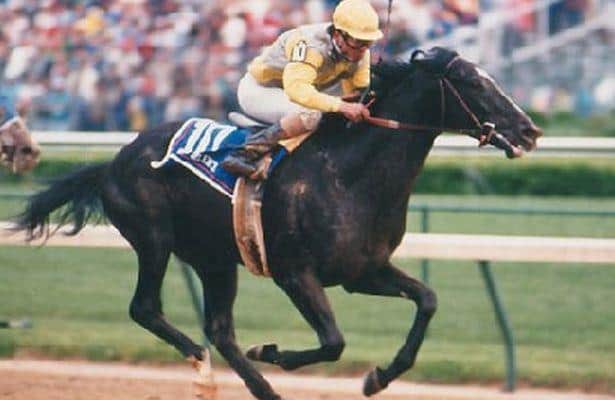
Black Consul was sired by Penmanship out of dam Madam Ambassador, purchased by Henrik Gál, and trained by Viktor Noel. Due to issues with illness, his planned debut in 1991 was delayed to February 1992.
On February 14, 1992, Black Consul made his debut at a 2000 meter race for previously unraced three-year-olds at Kiral Racecourse’s Republic Day meeting. His connections’ patience paid off: under jockey Bence Kende, Black Consul broke smoothly and pulled away from the pack to win by six lengths. Following this impressive victory, Black Consul was entered into that March’s Pkardia Stakes - a Listed race at Northern Racecourse over 1600 meters. Despite a late start, Black Consul quickly made up ground and wore down the leader to surge to a three-length win.
On May 17th, Black Consul entered the starting gate for his first graded race, the Grade 3 Spring Cup at Metropolitan Racecourse. Taking the lead early, Black Consul and Bence Kende fended off challengers to achieve another stunning three-length victory.
In July, Black Consul was once again moved up to compete in the Grade 2 Metro Cup. It would be his first time competing against older horses as his previous races were restricted to three-year-olds. The undefeated Colt broke well from the gate but found himself competing for the lead against Manifested - last year’s winner. Kende reigned in Black Consul’s power and settled in behind Manifested. The worn down Manifested failed to fend off Black Consul’s challenge in the final straight and lost by a half-length. On August 21, Black Consul repeated his performance at the August Mile, achieving a length-and-half margin of victory.
Despite being the popular favorite for the Triple Crown races later in the year, it was announced that Black Consul would have to skip the Káprázatos Cup and Central Stakes due to bone bruising. After his 90 day recovery period, Black Consul entered the gate for the 1992 Hexastalian Derby as the 1-5 second favorite behind Moneyline, the winner of the Central Stakes and runner up in the Káprázatos Cup. Once again ridden by Bence Kende, Black Consul took an early lead and was never substantially challenged, winning a four-length victory - an almost unheard of margin. His finishing time of 1:59.82 became the Derby’s record and remains the national record for 2000 meters.
His undefeated three-year-old season: six starts, six wins, and four graded wins, made him the unanimous choice for the HLH Award for Best Three-Year-Old Colt and HLH Horse of the Year.
Black Consul’s 1993 campaign started in April at the Royal Cup. Starting as the favorite, Black Consul evaded attempts by other competitors to restrain his speed. In the final straight, Black Consul fended off an attempt by Make My Mark and Light Minute to overtake and won by a half-length. Black Consul returned to the track four weeks later to run in the Soma Gold Cup. Having drawn a far inside post, Black Consul was quickly crowded and boxed in by other runners. With his unrestrained, front-running style nullified, Black Consul was unable to run to his full potential and finished off the board in seventh place. This was Black Consul’s first defeat and the end to his seven race winning streak. Several million Dinár had been bet on Black Consul in the race.
In July, Black Consul returned to defend his Metro Cup victory. This time, Kende ran him harder out the gate to prevent boxing and slipped through the front. Black Consul never faded during the race and won by a length. His next race was a repeat run of the August Mile, however, this time, he was dogged by other front-running horses and fell back to finish third. None of the other front-runners finished on the board.
On October 17, 1993, Black Consul stepped into the gates at Metropolitan Racecourse for the Champion Stakes. Under Kende, he started strongly, quickly making it to the front and leading by approximately twelve lengths. He recorded a 58.1 second split for the first 1000 meters, a very fast time. Near the fourth turn, Black Consul suddenly veered off track and slowed. Kende dismounted and kept the horse calm while veterinarians rushed to the scene. They found a severe fracture in Black Consul’s right foreleg, an injury that a horse cannot recover from. He was humanely euthanized shortly thereafter. Kende refused to leave the horse’s side during the procedure; he later commented, “He was a brilliant horse. Most horses would’ve thrown me and I’d be in the hospital now. It was the least I could do to pray for him in his final moments. I’m going to miss riding him a lot.”
Public outcry following Black Consul’s very public demise caused nationwide reforms of racehorse welfare and safety. Metropolitan racecourse introduced a specialized horse ambulance in 1994 and opened an expanded medical facility in 1995. While Black Consul’s death was likely impossible to prevent, his death was the catalyst that likely saved the lives of many horses after him.
The Black Consul Stakes were introduced in 1995 at Tó Park Racecourse as an ungraded event. In 1998, it was upgraded to a Listed event and in 2006, it was upgraded again to a Grade 3 race. Black Consul was cremated and buried at his home farm, but a statue was erected of him in the nearby town of Lovász. His plaque still stands in the HLH Hall of Fame.
Black Consul was sired by Penmanship out of dam Madam Ambassador, purchased by Henrik Gál, and trained by Viktor Noel. Due to issues with illness, his planned debut in 1991 was delayed to February 1992.
On February 14, 1992, Black Consul made his debut at a 2000 meter race for previously unraced three-year-olds at Kiral Racecourse’s Republic Day meeting. His connections’ patience paid off: under jockey Bence Kende, Black Consul broke smoothly and pulled away from the pack to win by six lengths. Following this impressive victory, Black Consul was entered into that March’s Pkardia Stakes - a Listed race at Northern Racecourse over 1600 meters. Despite a late start, Black Consul quickly made up ground and wore down the leader to surge to a three-length win.
On May 17th, Black Consul entered the starting gate for his first graded race, the Grade 3 Spring Cup at Metropolitan Racecourse. Taking the lead early, Black Consul and Bence Kende fended off challengers to achieve another stunning three-length victory.
In July, Black Consul was once again moved up to compete in the Grade 2 Metro Cup. It would be his first time competing against older horses as his previous races were restricted to three-year-olds. The undefeated Colt broke well from the gate but found himself competing for the lead against Manifested - last year’s winner. Kende reigned in Black Consul’s power and settled in behind Manifested. The worn down Manifested failed to fend off Black Consul’s challenge in the final straight and lost by a half-length. On August 21, Black Consul repeated his performance at the August Mile, achieving a length-and-half margin of victory.
Despite being the popular favorite for the Triple Crown races later in the year, it was announced that Black Consul would have to skip the Káprázatos Cup and Central Stakes due to bone bruising. After his 90 day recovery period, Black Consul entered the gate for the 1992 Hexastalian Derby as the 1-5 second favorite behind Moneyline, the winner of the Central Stakes and runner up in the Káprázatos Cup. Once again ridden by Bence Kende, Black Consul took an early lead and was never substantially challenged, winning a four-length victory - an almost unheard of margin. His finishing time of 1:59.82 became the Derby’s record and remains the national record for 2000 meters.
His undefeated three-year-old season: six starts, six wins, and four graded wins, made him the unanimous choice for the HLH Award for Best Three-Year-Old Colt and HLH Horse of the Year.
Black Consul’s 1993 campaign started in April at the Royal Cup. Starting as the favorite, Black Consul evaded attempts by other competitors to restrain his speed. In the final straight, Black Consul fended off an attempt by Make My Mark and Light Minute to overtake and won by a half-length. Black Consul returned to the track four weeks later to run in the Soma Gold Cup. Having drawn a far inside post, Black Consul was quickly crowded and boxed in by other runners. With his unrestrained, front-running style nullified, Black Consul was unable to run to his full potential and finished off the board in seventh place. This was Black Consul’s first defeat and the end to his seven race winning streak. Several million Dinár had been bet on Black Consul in the race.
In July, Black Consul returned to defend his Metro Cup victory. This time, Kende ran him harder out the gate to prevent boxing and slipped through the front. Black Consul never faded during the race and won by a length. His next race was a repeat run of the August Mile, however, this time, he was dogged by other front-running horses and fell back to finish third. None of the other front-runners finished on the board.
On October 17, 1993, Black Consul stepped into the gates at Metropolitan Racecourse for the Champion Stakes. Under Kende, he started strongly, quickly making it to the front and leading by approximately twelve lengths. He recorded a 58.1 second split for the first 1000 meters, a very fast time. Near the fourth turn, Black Consul suddenly veered off track and slowed. Kende dismounted and kept the horse calm while veterinarians rushed to the scene. They found a severe fracture in Black Consul’s right foreleg, an injury that a horse cannot recover from. He was humanely euthanized shortly thereafter. Kende refused to leave the horse’s side during the procedure; he later commented, “He was a brilliant horse. Most horses would’ve thrown me and I’d be in the hospital now. It was the least I could do to pray for him in his final moments. I’m going to miss riding him a lot.”
Public outcry following Black Consul’s very public demise caused nationwide reforms of racehorse welfare and safety. Metropolitan racecourse introduced a specialized horse ambulance in 1994 and opened an expanded medical facility in 1995. While Black Consul’s death was likely impossible to prevent, his death was the catalyst that likely saved the lives of many horses after him.
The Black Consul Stakes were introduced in 1995 at Tó Park Racecourse as an ungraded event. In 1998, it was upgraded to a Listed event and in 2006, it was upgraded again to a Grade 3 race. Black Consul was cremated and buried at his home farm, but a statue was erected of him in the nearby town of Lovász. His plaque still stands in the HLH Hall of Fame.
Longboard
Participant
- Pronouns
- He/Him
Horse racing has long history in Prydania, dating back to the old Adriannic Empire on Gothis, with roots in mythology as Thaunic gods are said to have raced their steeds. These traditions carried over to Craviter when the Heorotian vikings fled Andrenne and settled in what is now Prydania.
Horse racing evolved as a hobby amongst the nobility and became a side attraction at viking festivals, and later tournaments held by Kings and high ranking nobles.
Jousting, the main events of these festivals, began to wane in popularity beginning in the 16th century. By the 18th century the "blood sports" had been banned and horse racing had supplanted jousting as the primary attraction of these festivals.
Originally a sport of the nobility, tied with having the funds to breed thoroughbred horses, the sport saw a period of democratization in the early 1900s, with popular "jockies clubs" springing up. Still, it remained a purview of the upper and upper middle class.
Syndicalists were not inherently hostile to the sport at first, but its associations with the upper classes made it unpopular with the Syndicalist government of 2002-2017. Historic tracks and events were shuttered, and the sport all but vanished in the early 2010s.
The defeat of the Syndicalists in 2017 saw a slow but gradual return of the sport to Prydania, invested in by both the government and private individuals who saw its revival as a means to re-invigorate cultural touchstones that had been lost as a result of the Civil War
(Written and approved by @Prydania )
Longboard
Participant
- Pronouns
- He/Him
König (April 28, 1996 - March 9, 2022) was a Hexastalian thoroughbred racehorse best known for winning the 2001 Sutherland World Cup in an upset.
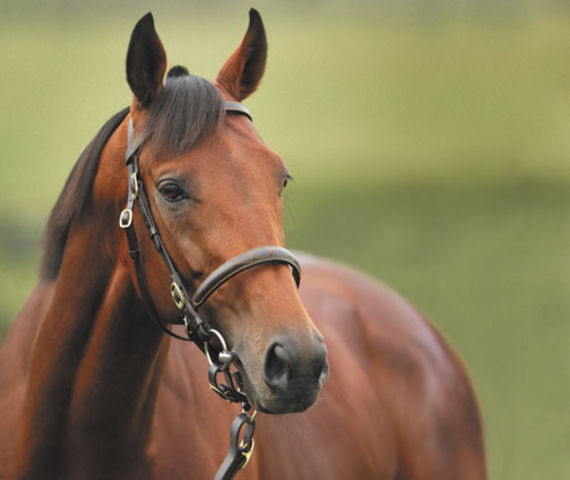
König was sired by Royal Sovereign out of Lily Girl. Royal Sovereign won the St. Eligius Classic in 1989 and was placed in several G1 races. Lily Girl won the 1990 Fair Lady Stakes but performed poorly at higher levels of competition. He was bought as a yearling by Alexander and Peter Vastag, brothers who had recently begun training horses, as the first horse for their stable in Pécsi.
König made his racecourse debut at Pécsi Racecourse on August 15, 1998. Originally meant to be ridden by veteran jockey Martin Veres, a family emergency left the brothers scrambling to find a jockey. They called in a favor from their friend, Jószef Balogh, a rookie jockey in his second year of riding. König went off as the 4th favorite to win in a seven-horse field. Balogh rode him towards the rear for most of the race, pulling clear in the final straight and winning by a length. The win brought the Vastag brothers their first win as owners and Balogh his first win at Pécsi.
A month later, König returned to the track at Pécsi to run in an allowance race for juveniles with one win. Once again saddled by Balogh, König ran in the back before making his move on the fourth corner. Balogh and König engaged in a fierce battle with another horse through the homestretch, winning by a nose. After the win, Balogh agreed to become the brothers’ first choice jockey.
After two months of training, König made his first stakes appearance in the Listed grade December Stakes at Árámlat Racecourse. This time, however, König failed to produce his strong late run and finished near the back of the pack.
In February 1999, König won his first race as a three-year-old in a two-win allowance race at Metropolitan Racecourse. He found another win in a three-win allowance race, once again at Pécsi, in April. This was followed by a return to Metropolitan Racecourse to contest the G3 Spring Cup in May. Despite running well through the start of the race, König eventually faded to finish a distant sixth out of twelve horses in his first graded stakes race. That summer, König ran in the ungraded Tisza Summer Handicap, where he won by three lengths and recorded a career-best speed figure.
On September 12, 1999, König entered the starting gate at Tó Park to contest the G3 Tó Derby. Among the fourteen horse field for the race was future Hexastalian Derby winner Skyline. König and Balogh ran in third along the rail for much of the race. Balogh launched his charge in the homestretch and challenged Skyline for the lead, eventually finishing second by a head. His performance in the race convinced the Vastag brothers and Balogh that the horse was Triple Crown material.
König was entered into the Káprázatos Cup alongside fourteen other horses. König ran on the outside near the rear for most of the race, produced a strong late run, but couldn’t catch the leaders and finished fourth. In the Central Stakes, König ran in second behind Greatest Game, who pulled ahead to win while König tired to finish an unimpressive thirteenth of sixteen horses. König was entered to run in the Hexastalian Derby but was scratched on the day before the race due to running a high temperature.
Despite his unimpressive performance in major races that year, König’s story caused his popularity to grow. The Vastag brothers had managed to get a horse into the Triple Crown races in their 2nd year as trainers, which was seen as a massive success story. They were seen as the stars of Pécsi by local racing fans. König, by extension, became a very popular horse at his home track in the city.
To start his four-year-old season, König ran in the ungraded Káprázatos Handicap in late March 2000. König was not mounted by Balogh in this race due to him contracting food poisoning at a party two days prior. Balogh’s replacement guided König to a hard-fought second-place finish, despite going off as the favorite to win. König returned to Pécsi afterwards and ran in the Baranja Stakes there in April. In front of a large hometown crowd and heavily favored to win, Balogh guided the horse to an overwhelming victory by four lengths. In late May, he contested Pécsi’s most important race: the Pécsi Derby. The race came down to König and defending champion Ferro in the final stretch, with König pulling away in the last fifty meters to grasp victory by the margin of a neck. After his defeat in Tó and his scratch at the Metro, König finally had his Derby.
Bolstered by strong hometown support, the Vastag brothers returned König to graded races after a break over the summer. In August, he returned to Tó Park for the G3 Lakefront Stakes. König started as the third favorite of fifteen horses, behind Falcon Stakes winner Harmonia and Cicero Stakes winner Genesis. König paced well behind front-runner Cicero Concentio before overtaking him on the fourth corner, fighting off a challenge by Harmonia, and winning by a half-length. It was König’s first graded win, and Peter Vastag was seen crying after the race. In September, König ran in the City Stakes at Metropolitan Racecourse and finished strongly in third place.
König returned to the races after a two-month layoff in December. In his first time at Kiral Racecourse, König would contest the St. Eligius Classic. Among the eighteen-horse field was Thunderhead, a two-time G1 winner, defending champion, and future leading sire in Hexastalia. After pacing in the mid-pack for most of the race, König launched his charge at the fourth corner but was passed and beaten by Thunderhead, finishing four lengths behind him in third. Despite the loss, König’s performance was such that he started attracting significant national attention.
König returned as a five-year-old in 2001, starting strong with a win in the G3 March Mile Stakes. In May, he went to Árámlat to run in the G1 Soma Gold Cup, where he found his best performance in a G1 race so far, placing second behind Mont Blanc by a length. In July, it was much the same; despite running well, König placed third behind Fighter Ace and the Sutheran horse Administration in the G2 Metro Cup. Fans found the horse’s consistently strong performance but lack of success at high levels admirable and increasingly identified themselves under the name Königsmänner, or Kingsmen.
König found his breakout success in September at the Autumn Stakes. After placing 4th in the August Mile, König was entered into the G2 Autumn Stakes at Káprázatos. Once again facing off with Mont Blanc, Balogh rode König aggressively through the race and chased down Mont Blanc in the homestretch, pulling ahead to win by three-quarters of a length. His third graded win and first win about Grade 3 was seen as a great accomplishment, and the Vastag brothers and Balogh drank for free at bars in Pécsi that weekend, according to local folklore.
Though originally planned to run in the Champion Stakes and St. Eligius Classic after his win, the Vastags were convinced to instead send König to the Sutherland World Cup. The nineteen-horse field consisted of eleven Sutheran competitors and eight international horses, including three other Hexastalians. The field was one of the most impressive collections of horses seen in the world at that time. König’s morning line odds started at 30-1, dropping to 42-1 by the time betting closed. König drew gate 3, an inside post.
Balogh hustled König out of the gate and managed to secure a position towards the front along the rail. König ran around sixth place through the first turn and backstretch, with multiple front-runners competing for position, setting an unusually fast pace for the race. As the leaders tired on the second turn, Balogh found a gap along the rail and took it, moving up to challenge the lead. On the fourth corner, König found himself running four-wide with the Sutheran horses Peppermynt, Ibissia Beach, and Titano. Balogh urged his horse forward in the straight with Peppermynt keeping pace until the last fifty meters when König took the lead to win by a nose.
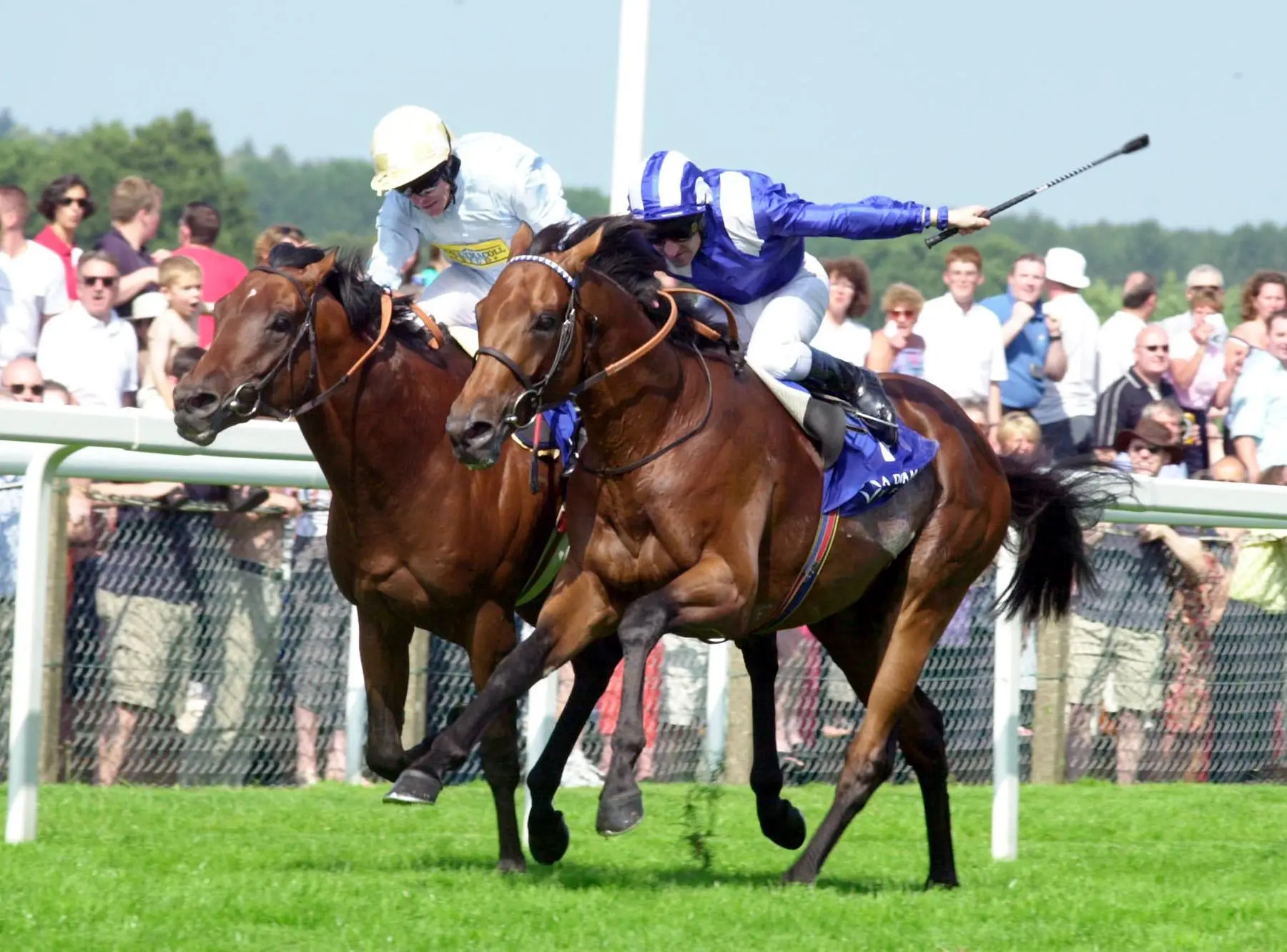 After the race, a teary Balogh said, “I kept asking him for more, and he kept giving me more. I could not have asked to ride a better horse today.” The race was Balogh’s first international G1. The race was simulcast to several racecourses around Hexastalia, including Pécsi, where a reporter described the cheers as “fit for a king”. The Vastags announced König’s immediate retirement after the race.
The Hexastalian race announcer’s call was far from neutral by the end. “It’s König on the inside and Peppermynt at his shoulder! Two hundred meters to go! Push, König, push! Peppermynt, König, Peppermynt, König? König! König leads! Do you believe in miracles? König!”
A retirement ceremony was held at Pécsi Racecourse in November, attended by almost 20,000 fans. In January, he was sent to stud at the Pécsi Stallion Station. In 2006, a statue of König and Balogh was installed in front of Pécsi Racecourse. König was pensioned from stud duty in 2018. He passed away on March 9, 2022, from old age, surrounded by staff. Less than two weeks later, a Sutheran granddaughter of König, Princess Lilith, won the G1 Peppermynt Stakes. A grandson of König, Avalonian, ran second in all three Triple Crown races in 2025.
König was sired by Royal Sovereign out of Lily Girl. Royal Sovereign won the St. Eligius Classic in 1989 and was placed in several G1 races. Lily Girl won the 1990 Fair Lady Stakes but performed poorly at higher levels of competition. He was bought as a yearling by Alexander and Peter Vastag, brothers who had recently begun training horses, as the first horse for their stable in Pécsi.
König made his racecourse debut at Pécsi Racecourse on August 15, 1998. Originally meant to be ridden by veteran jockey Martin Veres, a family emergency left the brothers scrambling to find a jockey. They called in a favor from their friend, Jószef Balogh, a rookie jockey in his second year of riding. König went off as the 4th favorite to win in a seven-horse field. Balogh rode him towards the rear for most of the race, pulling clear in the final straight and winning by a length. The win brought the Vastag brothers their first win as owners and Balogh his first win at Pécsi.
A month later, König returned to the track at Pécsi to run in an allowance race for juveniles with one win. Once again saddled by Balogh, König ran in the back before making his move on the fourth corner. Balogh and König engaged in a fierce battle with another horse through the homestretch, winning by a nose. After the win, Balogh agreed to become the brothers’ first choice jockey.
After two months of training, König made his first stakes appearance in the Listed grade December Stakes at Árámlat Racecourse. This time, however, König failed to produce his strong late run and finished near the back of the pack.
In February 1999, König won his first race as a three-year-old in a two-win allowance race at Metropolitan Racecourse. He found another win in a three-win allowance race, once again at Pécsi, in April. This was followed by a return to Metropolitan Racecourse to contest the G3 Spring Cup in May. Despite running well through the start of the race, König eventually faded to finish a distant sixth out of twelve horses in his first graded stakes race. That summer, König ran in the ungraded Tisza Summer Handicap, where he won by three lengths and recorded a career-best speed figure.
On September 12, 1999, König entered the starting gate at Tó Park to contest the G3 Tó Derby. Among the fourteen horse field for the race was future Hexastalian Derby winner Skyline. König and Balogh ran in third along the rail for much of the race. Balogh launched his charge in the homestretch and challenged Skyline for the lead, eventually finishing second by a head. His performance in the race convinced the Vastag brothers and Balogh that the horse was Triple Crown material.
König was entered into the Káprázatos Cup alongside fourteen other horses. König ran on the outside near the rear for most of the race, produced a strong late run, but couldn’t catch the leaders and finished fourth. In the Central Stakes, König ran in second behind Greatest Game, who pulled ahead to win while König tired to finish an unimpressive thirteenth of sixteen horses. König was entered to run in the Hexastalian Derby but was scratched on the day before the race due to running a high temperature.
Despite his unimpressive performance in major races that year, König’s story caused his popularity to grow. The Vastag brothers had managed to get a horse into the Triple Crown races in their 2nd year as trainers, which was seen as a massive success story. They were seen as the stars of Pécsi by local racing fans. König, by extension, became a very popular horse at his home track in the city.
To start his four-year-old season, König ran in the ungraded Káprázatos Handicap in late March 2000. König was not mounted by Balogh in this race due to him contracting food poisoning at a party two days prior. Balogh’s replacement guided König to a hard-fought second-place finish, despite going off as the favorite to win. König returned to Pécsi afterwards and ran in the Baranja Stakes there in April. In front of a large hometown crowd and heavily favored to win, Balogh guided the horse to an overwhelming victory by four lengths. In late May, he contested Pécsi’s most important race: the Pécsi Derby. The race came down to König and defending champion Ferro in the final stretch, with König pulling away in the last fifty meters to grasp victory by the margin of a neck. After his defeat in Tó and his scratch at the Metro, König finally had his Derby.
Bolstered by strong hometown support, the Vastag brothers returned König to graded races after a break over the summer. In August, he returned to Tó Park for the G3 Lakefront Stakes. König started as the third favorite of fifteen horses, behind Falcon Stakes winner Harmonia and Cicero Stakes winner Genesis. König paced well behind front-runner Cicero Concentio before overtaking him on the fourth corner, fighting off a challenge by Harmonia, and winning by a half-length. It was König’s first graded win, and Peter Vastag was seen crying after the race. In September, König ran in the City Stakes at Metropolitan Racecourse and finished strongly in third place.
König returned to the races after a two-month layoff in December. In his first time at Kiral Racecourse, König would contest the St. Eligius Classic. Among the eighteen-horse field was Thunderhead, a two-time G1 winner, defending champion, and future leading sire in Hexastalia. After pacing in the mid-pack for most of the race, König launched his charge at the fourth corner but was passed and beaten by Thunderhead, finishing four lengths behind him in third. Despite the loss, König’s performance was such that he started attracting significant national attention.
König returned as a five-year-old in 2001, starting strong with a win in the G3 March Mile Stakes. In May, he went to Árámlat to run in the G1 Soma Gold Cup, where he found his best performance in a G1 race so far, placing second behind Mont Blanc by a length. In July, it was much the same; despite running well, König placed third behind Fighter Ace and the Sutheran horse Administration in the G2 Metro Cup. Fans found the horse’s consistently strong performance but lack of success at high levels admirable and increasingly identified themselves under the name Königsmänner, or Kingsmen.
König found his breakout success in September at the Autumn Stakes. After placing 4th in the August Mile, König was entered into the G2 Autumn Stakes at Káprázatos. Once again facing off with Mont Blanc, Balogh rode König aggressively through the race and chased down Mont Blanc in the homestretch, pulling ahead to win by three-quarters of a length. His third graded win and first win about Grade 3 was seen as a great accomplishment, and the Vastag brothers and Balogh drank for free at bars in Pécsi that weekend, according to local folklore.
Though originally planned to run in the Champion Stakes and St. Eligius Classic after his win, the Vastags were convinced to instead send König to the Sutherland World Cup. The nineteen-horse field consisted of eleven Sutheran competitors and eight international horses, including three other Hexastalians. The field was one of the most impressive collections of horses seen in the world at that time. König’s morning line odds started at 30-1, dropping to 42-1 by the time betting closed. König drew gate 3, an inside post.
Balogh hustled König out of the gate and managed to secure a position towards the front along the rail. König ran around sixth place through the first turn and backstretch, with multiple front-runners competing for position, setting an unusually fast pace for the race. As the leaders tired on the second turn, Balogh found a gap along the rail and took it, moving up to challenge the lead. On the fourth corner, König found himself running four-wide with the Sutheran horses Peppermynt, Ibissia Beach, and Titano. Balogh urged his horse forward in the straight with Peppermynt keeping pace until the last fifty meters when König took the lead to win by a nose.
The Hexastalian race announcer’s call was far from neutral by the end. “It’s König on the inside and Peppermynt at his shoulder! Two hundred meters to go! Push, König, push! Peppermynt, König, Peppermynt, König? König! König leads! Do you believe in miracles? König!”
A retirement ceremony was held at Pécsi Racecourse in November, attended by almost 20,000 fans. In January, he was sent to stud at the Pécsi Stallion Station. In 2006, a statue of König and Balogh was installed in front of Pécsi Racecourse. König was pensioned from stud duty in 2018. He passed away on March 9, 2022, from old age, surrounded by staff. Less than two weeks later, a Sutheran granddaughter of König, Princess Lilith, won the G1 Peppermynt Stakes. A grandson of König, Avalonian, ran second in all three Triple Crown races in 2025.
Last edited:
Longboard
Participant
- Pronouns
- He/Him
Astoria (foaled April 29, 2022) is a multiple Grade 1-winning thoroughbred racehorse. She was awarded the 2025 HLH Award for Best Three-Year-Old Filly.
Astoria is a bay filly with a white blaze and white socks on her left fore and hind legs. She was bred by Luca Szekeres from the Northern Lights mare Multitalented by Deneb, the winner of the 2007 Hexastalian Derby. She was sold at the Soma Spring Breeze Up Sale in 2024 to Mihály Deák’s Prospector Stables for 14,000,000 Hexastalian Dinár (2,089,552 IBU). Deák sent her to train with Peter Vastag. Astoria was named after the four-star Hotel Astoria in Hexstal.
Astoria made her racecourse debut on 3 September 2024 at Metropolitan Racecourse in a 1600-meter maiden race under jockey László Domonkos. Starting as the odds-on favorite in a field of thirteen, Astoria settled in the midpack and ran strongly towards the end, but failed to catch the leading Atta Boy and lost by a length. Astoria returned for another maiden race at Metropolitan under Domonkos, this time over 1800 meters on 23 September. Once again sent off as the favorite, Astoria moved up steadily along the final turn, overtook the leaders, and clocked an impressive-looking win by a margin of four lengths. She was made the betting favorite in the December Stakes at Kiral Racecourse on 8 December. Going off odds-on once again, Astoria failed to fire in her late run and finished a disappointing seventh of twelve horses to end her juvenile season.
Astoria started her three-year-old season in the Grade 2 Rose Stakes. Astoria was sent off as the fourth favorite at 6-1 odds. After settling sixth place along the rail, she slipped between horses at the fourth corner before Convergence rallied to edge her out by a neck. Astoria’s next start was Pécsi Oaks in June. This time, Arthur Nagy took the reins as Domonkos was busy elsewhere. Rallying strongly from the outside, Astoria took the lead two furlongs from the finish and expanded that lead to win by over three lengths from the second-place finisher. Following her strong finish, Vastag announced that Astoria would be heading to the Hexastalian Oaks in December. These plans were nearly foiled, however, when Astoria suffered a fracture of her right foreleg during training in July. Though not fatal, it delayed her connections’ plans to return her to racing.
Nevertheless, Astoria recovered in time to enter the gate at the Hexastalian Oaks. She would be sent off as the third favorite behind Convergence and She’s A Lady (winner: Queen Stakes). Once again guided by Domonkos, Astoria sat off the pace this time in midpack, closed steadily through the second turn, and gained the lead at the fourth corner. Convergence rallied late to challenge but couldn’t catch Astoria, who ran away with the race by two lengths. She’s A Lady was a non-factor. Astoria received the 2025 HLH Award for Best Three-Year-Old Filly for her performance in the Oaks.
Astoria made her four-year-old debut on 11 April 2026, in the Weskermere Grand Prix against strong international competition and her first run against open age competition. Due to the prevalence of front-running speed horses in the race, Balogh and Domonkos decided to run Astoria as an even deeper closer than usual. She started slow and found a spot on the rail at the rear of the pack, third from last. The speed horses set high fractional times as they battled for the lead, leading to a pace breakdown in the final straight. Domonkos swung Astoria wide and charged down the center of the track, taking the lead in the final furlongs and widening her lead to win by over four lengths from Weiss Beauty.
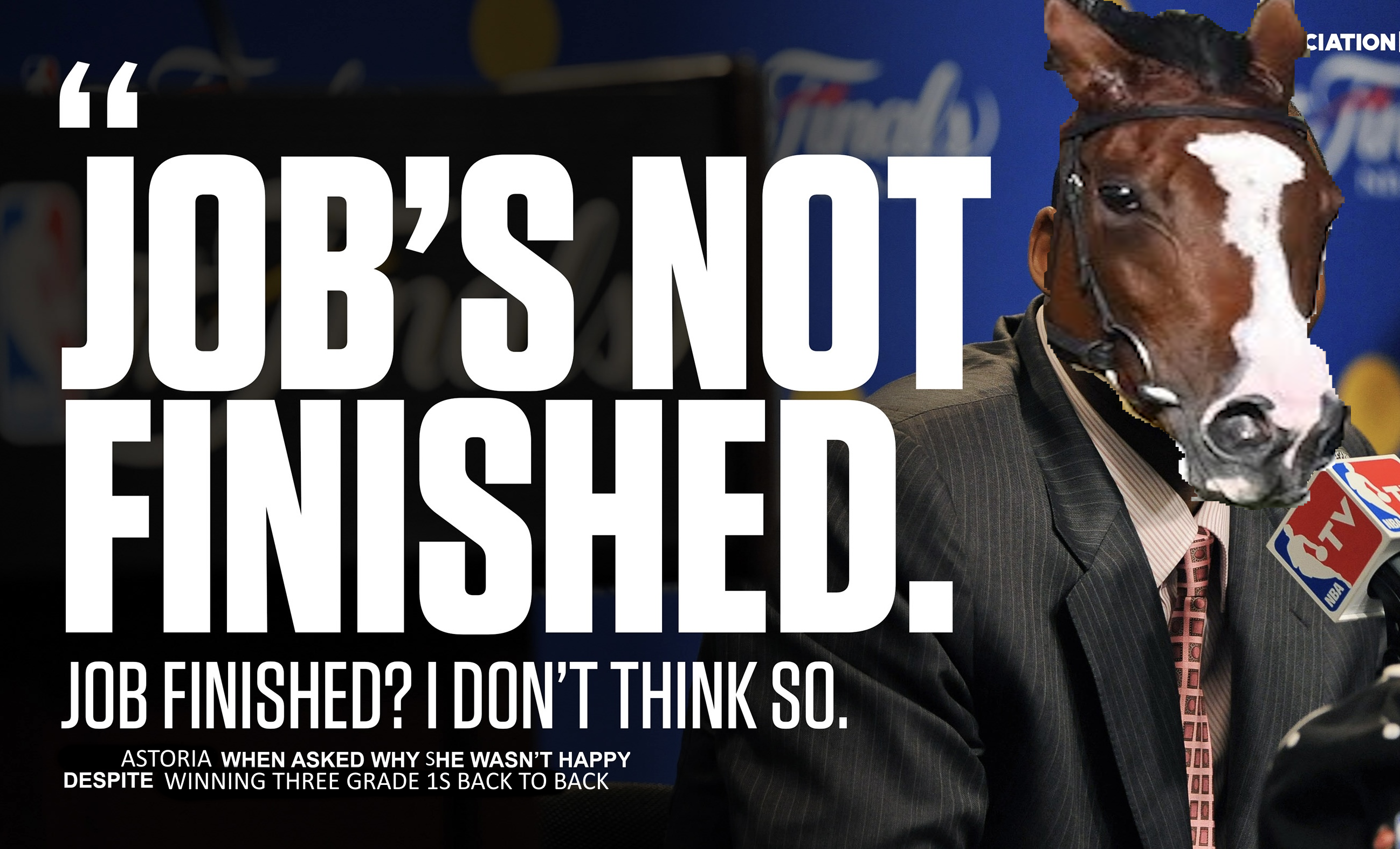
In her strongest challenge yet, Astoria entered the Soma Gold Cup on 23 May. She lined up against Winter Gale (winner: 2024 Junior Cup, 2025 Káprázatos Cup, 2025 Central Stakes, 2025 Hexastalian Derby), Weiss Beauty (2024 Káprázatos Cup), Pálinka (2026 Queen of the Turf Stakes), Belleville (2026 Royal Cup), Avalonian, and Good as Gold. She went off as the second favorite at 7-2 odds. This time, the pace was set up less in her favor as Good as Gold was unchallenged at the front. Winter Gale rallied from off the pace at the fourth corner to gain the lead with Avalonian tracking closely. Astoria charged up the center from midpack, caught Winter Gale, and won by a head in the final 50 meters. Less than a half-length separated Astoria from Avalonian in third. This win earned Astoria a RaceNet Rating of 121, the highest earned by any Hexastalian horse in 2026 so far.
Astoria is a bay filly with a white blaze and white socks on her left fore and hind legs. She was bred by Luca Szekeres from the Northern Lights mare Multitalented by Deneb, the winner of the 2007 Hexastalian Derby. She was sold at the Soma Spring Breeze Up Sale in 2024 to Mihály Deák’s Prospector Stables for 14,000,000 Hexastalian Dinár (2,089,552 IBU). Deák sent her to train with Peter Vastag. Astoria was named after the four-star Hotel Astoria in Hexstal.
Astoria made her racecourse debut on 3 September 2024 at Metropolitan Racecourse in a 1600-meter maiden race under jockey László Domonkos. Starting as the odds-on favorite in a field of thirteen, Astoria settled in the midpack and ran strongly towards the end, but failed to catch the leading Atta Boy and lost by a length. Astoria returned for another maiden race at Metropolitan under Domonkos, this time over 1800 meters on 23 September. Once again sent off as the favorite, Astoria moved up steadily along the final turn, overtook the leaders, and clocked an impressive-looking win by a margin of four lengths. She was made the betting favorite in the December Stakes at Kiral Racecourse on 8 December. Going off odds-on once again, Astoria failed to fire in her late run and finished a disappointing seventh of twelve horses to end her juvenile season.
Astoria started her three-year-old season in the Grade 2 Rose Stakes. Astoria was sent off as the fourth favorite at 6-1 odds. After settling sixth place along the rail, she slipped between horses at the fourth corner before Convergence rallied to edge her out by a neck. Astoria’s next start was Pécsi Oaks in June. This time, Arthur Nagy took the reins as Domonkos was busy elsewhere. Rallying strongly from the outside, Astoria took the lead two furlongs from the finish and expanded that lead to win by over three lengths from the second-place finisher. Following her strong finish, Vastag announced that Astoria would be heading to the Hexastalian Oaks in December. These plans were nearly foiled, however, when Astoria suffered a fracture of her right foreleg during training in July. Though not fatal, it delayed her connections’ plans to return her to racing.
Nevertheless, Astoria recovered in time to enter the gate at the Hexastalian Oaks. She would be sent off as the third favorite behind Convergence and She’s A Lady (winner: Queen Stakes). Once again guided by Domonkos, Astoria sat off the pace this time in midpack, closed steadily through the second turn, and gained the lead at the fourth corner. Convergence rallied late to challenge but couldn’t catch Astoria, who ran away with the race by two lengths. She’s A Lady was a non-factor. Astoria received the 2025 HLH Award for Best Three-Year-Old Filly for her performance in the Oaks.
Astoria made her four-year-old debut on 11 April 2026, in the Weskermere Grand Prix against strong international competition and her first run against open age competition. Due to the prevalence of front-running speed horses in the race, Balogh and Domonkos decided to run Astoria as an even deeper closer than usual. She started slow and found a spot on the rail at the rear of the pack, third from last. The speed horses set high fractional times as they battled for the lead, leading to a pace breakdown in the final straight. Domonkos swung Astoria wide and charged down the center of the track, taking the lead in the final furlongs and widening her lead to win by over four lengths from Weiss Beauty.
In her strongest challenge yet, Astoria entered the Soma Gold Cup on 23 May. She lined up against Winter Gale (winner: 2024 Junior Cup, 2025 Káprázatos Cup, 2025 Central Stakes, 2025 Hexastalian Derby), Weiss Beauty (2024 Káprázatos Cup), Pálinka (2026 Queen of the Turf Stakes), Belleville (2026 Royal Cup), Avalonian, and Good as Gold. She went off as the second favorite at 7-2 odds. This time, the pace was set up less in her favor as Good as Gold was unchallenged at the front. Winter Gale rallied from off the pace at the fourth corner to gain the lead with Avalonian tracking closely. Astoria charged up the center from midpack, caught Winter Gale, and won by a head in the final 50 meters. Less than a half-length separated Astoria from Avalonian in third. This win earned Astoria a RaceNet Rating of 121, the highest earned by any Hexastalian horse in 2026 so far.
Last edited:
Share: