
You are using an out of date browser. It may not display this or other websites correctly.
You should upgrade or use an alternative browser.
You should upgrade or use an alternative browser.
Scalvian Worldbuilding (Revised Edition)
- Thread starter Predice
- Start date
-
- Tags
- scalvia worldbuilding

Predice
TNPer
Emergency Broadcasting in Scalvia
Introduction
Emergency warning and broadcast systems are an important part of most countries’ emergency response. Information is a crucial component of survival that emergency broadcasting and warning systems can provide. The same is the case in Scalvia, which has operated a codified emergency broadcasting system of some sort since the 1950s.
CDBS: Beginnings
During the 1950s and 1960s, the Commonwealth Civil Defence Administration (CCDA) created the Civil Defence Broadcast Service or (CDBS) to be transmitted on 640 AM or 1240 AM. In the event of an attack, all Television stations would cease broadcasting, and all AM radio stations would broadcast on 640 or 1240 kHz on the AM band. The idea behind the CDBS was to allow for the Prime Minister (and the Government more broadly) to reach as many citizens as possible, as quickly as possible, in the event of a national emergency such as a nuclear attack. The system consisted of a number of commercial broadcast stations designated as “Primary Stations” as well as a larger number of subsidiary relay stations. Once the Primary Stations received an alert from the Government, they would transmit an activation signal consisting of shutting the transmitter off for five seconds, turning it back on for five seconds, shutting it off for five seconds again, and then transmitting a 1000 Hz tone for fifteen seconds. Upon receiving this signal, the relay stations would cease regular programming and switch their transmission to either 640 or 1240 AM and await further instructions. Any station not part of the system would shut down. Because back in those days, as today, there are many amateur radio stations in Scalvia, radio amateurs could purchase a CDBS detection unit from companies like Radisson which would connect to their transmitter and upon receiving the CDBS activation signal, the unit would automatically cut power to the transmitter.
Upon the system’s activation, the Government could broadcast news, official instructions and information to anyone who could tune into those stations. So to ensure that as many people had access to the system as possible, all radios sold commercially in Scalvia from 1954 to 1965 were required to in some way specially mark 640 and 1240 AM, usually this was done by a triangle and circle.

CDBS marked car radio
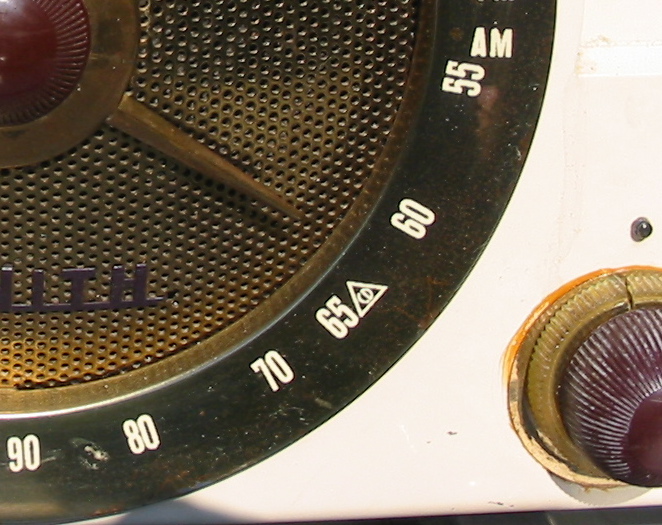
Radio dial with CDBS marking
Another major component of the CDBS was a system that switched their broadcast duties between different stations in sequential order in order to avoid creating a homing beacon for enemy nuclear bombers.
All of this sounds pretty simple and straightforward in theory, but in practice the CDBS had serious flaws.
CDBS: Flaws
The CDBS experienced two pretty embarrassing false alarms in 1956 and 1958 respectively. The first of these was triggered on July 18th, 1956 when a Scalvian Air Defence Radar Station in northern Leišmale detected what they believed to be a formation of Suavidici Bombers. The Air Defence Command, Northern Division raised the alarm and attempted to activate the CDBS system. The result? Utter chaos. As it turned out, most participant stations were either not trained very well, or were so out of practice that they had absolutely no clue what to do. Most of them failed to respond, not ceasing to broadcast, nor switching over to one of the designated frequencies. Only around a fifth of the system actually activated, and the whole alert was called off after about ten minutes when it was determined that the incoming contacts were not actually Suavidici bombers, but instead Scalvian bombers carrying out a routine training flight.
The second false alarm occurred on January 6th, 1958, and was triggered by a miscommunication. The Air Defence Command (ADC) was attempting to send a routine communications check signal, but instead of sending the correct signal “This is an Air Defence Line Check,” they instead sent “This is an Air Defence Radio Alert.”
This caused WKIV in Kariste to activate the CDBS system. In a “shocking” development, most of the relay stations once again had no idea what to do with the alert, and only a small number went through the procedure properly. It was an embarrassment. Another major flaw, and a pretty fundamental one, with the CDBS was the fact that you needed to know that there was an attack taking place in order to tune to the CDBS frequencies. There was no way of reaching people who weren’t already tuned in or didn’t already know what was happening. The round-robin switching system that was supposed to prevent enemy bombers having a homing beacon to find their targets was also largely useless, as most stations were clustered around a small area, typically the Primary Stations, meaning that despite the switching, enemy bombers could still easily find large targets like cities. For these and many other reasons CDBS was finally phased out and replaced in 1965.
EADS: The clever yet flawed solution
Between 1958 and 1965, the Scalvian Government attempted to replace CDBS with the Emergency Alarm Distribution System (EADS,) a rather clever device that did not rely on radio reception to get its alert signal, but rather could be plugged directly into a regular household outlet and received its signal through the electrical mains by modulating the alternating current coming through it.
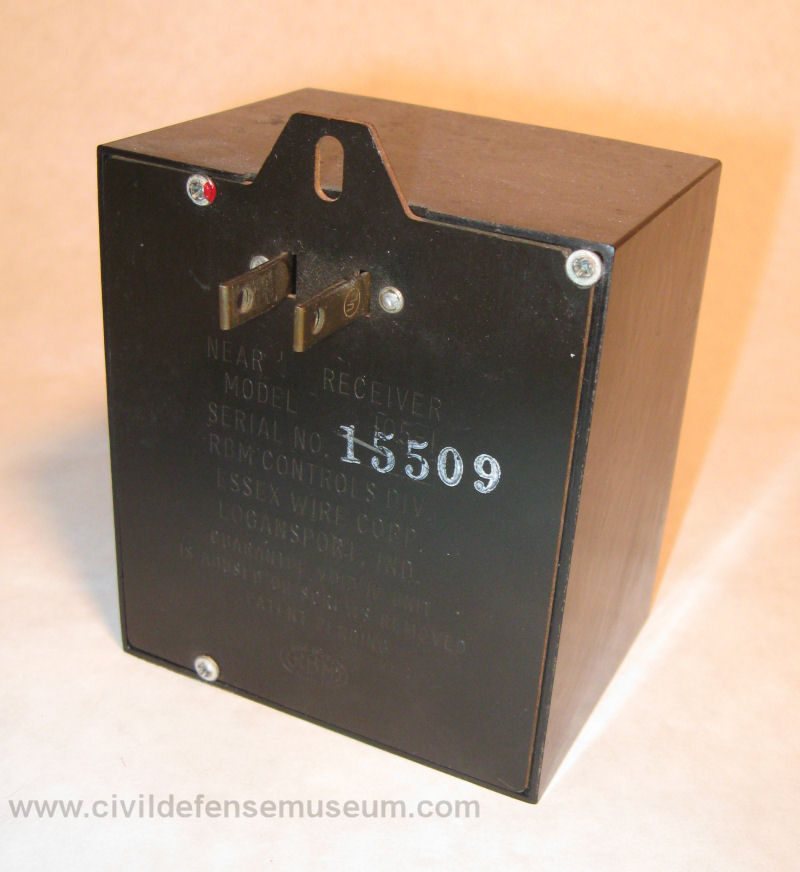
EADS plug-in repeater
Thus you didn’t actually have to be tuned in to receive a signal, you could receive an alert signal no matter what you were doing, so long as your home was receiving electricity. This was a major advantage over the CDBS but also proved to be its Achilles’ heel due to the fragility of the national electrical grid; the electricity could easily be knocked out by either a nuclear weapon detonating near electrical infrastructure, or by the electromagnetic pulse generated by a high altitude nuclear detonation. For these reasons and others, the EADS program was cancelled, and all units ordered destroyed on May 11th, 1965.
PAWS: Here for the long haul
On May 11th, 1965 the CDBS and EADS were replaced by the Public Alert and Warning System (PAWS.)
In many ways PAWS was very similar to CDBS, except that instead of designating specific frequencies for emergency broadcasts, the system took over the entire national broadcast network, and used the same frequencies that would normally be used to transmit regular commercial programming. Under this system, an alert could originate with the Air Defence Command (ADC) or the Commonwealth Civil Defence Administration (CCDA.)
The ADC or CCDA would transmit an Emergency Activation Notice (EAN) via News Agency wire services through teletype. This notice consisted of a series of X’s across the page and the teletype bell ringing a certain number of times, which would inform a broadcaster that an alert was forthcoming. A set of test authenticator words would then be sent out, with every broadcaster required to have a special envelope with codewords printed on the outside, and another set of codewords sealed inside of the envelope. The words on the outside of the envelope would then have to be compared to the ones being received by teletype, and if any one of them didn’t match, the envelope would have to be opened to compare the words inside and translate the message being relayed. All regular programming would then be terminated and the appropriate emergency message would be transmitted over the regular broadcast frequencies.
To avoid the complacency and lack of training that had plagued the CDBS, broadcasters were required to conduct a test of the Public Alert and Warning System once per week during the hours of 07:30AM and local sunset. Most broadcasters (unsurprisingly) scheduled these tests during periods of low viewership to avoid annoying their viewers. Originally the activation signal that was broadcast out was the same as CDBS, so turning the transmitter off for five seconds, on for five seconds, off for five seconds and then broadcasting a 1000 Hz tone for fifteen seconds. Unfortunately, however, a lot of transmitters couldn’t take that kind of power cycling, and tended to just shut down. Thus, this procedure became known jokingly as the “PAWS stress test.”
Because knocking a bunch of the transmitters in your system offline is far from the optimal solution, this procedure was replaced by a new alert tone mixing the frequencies 853 and 960 Hz, specifically due to its unpleasantness to the human ear, now famously known as the “Attention Signal” in Scalvia, or infamously as the “PAWS Screech” which is still used in Scalvian Emergency Warning Systems today.
PAWS: A flawed system like CDBS
All of this seems very straightforward in theory, and a massive improvement over CDBS, however in practice PAWS also turned out to have some massive flaws, which were laid bare by a false alarm on April 18th, 1973, when a Government teletype operator mistakenly sent out the wrong codeword, specifically “Xylophone.” Because this did not match the words on the outside of the envelopes in the broadcast stations for that day, a lot of stations started the activation procedure for the PAWS. This alert lasted for nearly an hour, as the teletype operator kept screwing up the termination signal, as he kept writing in the wrong word. It took him five unsuccessful tries before he was finally able to shut the alert down. If that was it, then that would have been fine; it would have been a great test of PAWS, unfortunately as with CDBS, most of the stations were clueless as to what to do with this alert, and only around a quarter of the stations actually activated the PAWS as per the proper procedure. Not a great look. Following this, PAWS tests were temporarily suspended, not returning until two years later in March, 1975.
When PAWS returned, some significant changes had been made to the procedure.
First: the Emergency Activation Notices would be sent through the news desks of the various wire services, as well as the Government Information Office for vetting, introducing a one minute delay to the notice reaching the public; also in the original system there were two different messages, one for a more general alert and one for a specific alert. Because the specific alert was thought to cause far too much panic, only the general alert was retained.
Finally, government broadcast stations were ordered to keep the tapes with the authenticator words away from the transmitters to avoid a repeat of the 1973 incident.
Yet despite these improvements it was soon realised that not only was PAWS deeply flawed, but that it was also somewhat redundant, given developments in broadcast technology and culture.
Nonetheless, PAWS remained in service until January 1st, 2000 when it was replaced by the Scalvian Emergency Broadcasting System (SEBS.)
SEBS: The Modern Solution

SAME Receiver
SEBS is roughly similar to PAWS, except that it uses a system of digitally encoded headers, known as SAME or Specific Area Message Encoding, in order to route a message to a specific relevant area, being the first in the world to integrate this system. It is worth mentioning that it is illegal to broadcast these SAME Headers unless there is an actual emergency. SAME means the system can be used not only for national level emergencies (like nuclear war) but also for local emergencies and natural disasters. The system comprises 58 Primary Stations, also known as Primary Entry Points (PEPs) scattered across the country, which can be used to transmit both local and national emergency alerts, which are triggered by the various SAME headers, the most serious of which is the Emergency Action Notification or the National Emergency Message (EAN and NEM respectively,) which indicates that the President or PM will speak to the nation within ten minutes. It can be deactivated in one of two ways; one is the End of Message (EOM) which allows the station to stop broadcasting the message, but crucially does not allow for a return to regular programming, instead requiring the station to wait for further instructions. The other way is by transmitting the Emergency Action Termination (EAT) or National Emergency Termination (NET) which allows the station to return to regular programming.
In 2010, SEBS was integrated into the wider SCALERT system. The SCALERT (Scalvian Alert System) includes not only SEBS, but also the National Warning System (NWS,) essentially a thousand phone party line connecting state emergency operations centres, and National Weather Service field offices, which allows alerts on severe weather events and other natural disasters to be quickly and efficiently transmitted, in addition it includes the Public Siren System (PSS,) a system of thousands of public siren systems, it also includes the National Weather Service All Hazards Weather Radio, and finally SCALERT includes the Wireless Emergency Warning System (WEWS,) which sends out national and local alerts via text message.
Conclusion
Scalvia was one of the first countries to seriously explore emergency broadcasting, and today has one of the most extensive emergency broadcast systems. Its SAME system allows for the rapid dissemination of information, and the use of the system for even local emergencies, making Scalvia’s SCALERT perhaps one of the most flexible public warning systems in Eras.
Introduction
Emergency warning and broadcast systems are an important part of most countries’ emergency response. Information is a crucial component of survival that emergency broadcasting and warning systems can provide. The same is the case in Scalvia, which has operated a codified emergency broadcasting system of some sort since the 1950s.
CDBS: Beginnings
During the 1950s and 1960s, the Commonwealth Civil Defence Administration (CCDA) created the Civil Defence Broadcast Service or (CDBS) to be transmitted on 640 AM or 1240 AM. In the event of an attack, all Television stations would cease broadcasting, and all AM radio stations would broadcast on 640 or 1240 kHz on the AM band. The idea behind the CDBS was to allow for the Prime Minister (and the Government more broadly) to reach as many citizens as possible, as quickly as possible, in the event of a national emergency such as a nuclear attack. The system consisted of a number of commercial broadcast stations designated as “Primary Stations” as well as a larger number of subsidiary relay stations. Once the Primary Stations received an alert from the Government, they would transmit an activation signal consisting of shutting the transmitter off for five seconds, turning it back on for five seconds, shutting it off for five seconds again, and then transmitting a 1000 Hz tone for fifteen seconds. Upon receiving this signal, the relay stations would cease regular programming and switch their transmission to either 640 or 1240 AM and await further instructions. Any station not part of the system would shut down. Because back in those days, as today, there are many amateur radio stations in Scalvia, radio amateurs could purchase a CDBS detection unit from companies like Radisson which would connect to their transmitter and upon receiving the CDBS activation signal, the unit would automatically cut power to the transmitter.
Upon the system’s activation, the Government could broadcast news, official instructions and information to anyone who could tune into those stations. So to ensure that as many people had access to the system as possible, all radios sold commercially in Scalvia from 1954 to 1965 were required to in some way specially mark 640 and 1240 AM, usually this was done by a triangle and circle.
CDBS marked car radio
Radio dial with CDBS marking
Another major component of the CDBS was a system that switched their broadcast duties between different stations in sequential order in order to avoid creating a homing beacon for enemy nuclear bombers.
All of this sounds pretty simple and straightforward in theory, but in practice the CDBS had serious flaws.
CDBS: Flaws
The CDBS experienced two pretty embarrassing false alarms in 1956 and 1958 respectively. The first of these was triggered on July 18th, 1956 when a Scalvian Air Defence Radar Station in northern Leišmale detected what they believed to be a formation of Suavidici Bombers. The Air Defence Command, Northern Division raised the alarm and attempted to activate the CDBS system. The result? Utter chaos. As it turned out, most participant stations were either not trained very well, or were so out of practice that they had absolutely no clue what to do. Most of them failed to respond, not ceasing to broadcast, nor switching over to one of the designated frequencies. Only around a fifth of the system actually activated, and the whole alert was called off after about ten minutes when it was determined that the incoming contacts were not actually Suavidici bombers, but instead Scalvian bombers carrying out a routine training flight.
The second false alarm occurred on January 6th, 1958, and was triggered by a miscommunication. The Air Defence Command (ADC) was attempting to send a routine communications check signal, but instead of sending the correct signal “This is an Air Defence Line Check,” they instead sent “This is an Air Defence Radio Alert.”
This caused WKIV in Kariste to activate the CDBS system. In a “shocking” development, most of the relay stations once again had no idea what to do with the alert, and only a small number went through the procedure properly. It was an embarrassment. Another major flaw, and a pretty fundamental one, with the CDBS was the fact that you needed to know that there was an attack taking place in order to tune to the CDBS frequencies. There was no way of reaching people who weren’t already tuned in or didn’t already know what was happening. The round-robin switching system that was supposed to prevent enemy bombers having a homing beacon to find their targets was also largely useless, as most stations were clustered around a small area, typically the Primary Stations, meaning that despite the switching, enemy bombers could still easily find large targets like cities. For these and many other reasons CDBS was finally phased out and replaced in 1965.
EADS: The clever yet flawed solution
Between 1958 and 1965, the Scalvian Government attempted to replace CDBS with the Emergency Alarm Distribution System (EADS,) a rather clever device that did not rely on radio reception to get its alert signal, but rather could be plugged directly into a regular household outlet and received its signal through the electrical mains by modulating the alternating current coming through it.
EADS plug-in repeater
Thus you didn’t actually have to be tuned in to receive a signal, you could receive an alert signal no matter what you were doing, so long as your home was receiving electricity. This was a major advantage over the CDBS but also proved to be its Achilles’ heel due to the fragility of the national electrical grid; the electricity could easily be knocked out by either a nuclear weapon detonating near electrical infrastructure, or by the electromagnetic pulse generated by a high altitude nuclear detonation. For these reasons and others, the EADS program was cancelled, and all units ordered destroyed on May 11th, 1965.
PAWS: Here for the long haul
On May 11th, 1965 the CDBS and EADS were replaced by the Public Alert and Warning System (PAWS.)
In many ways PAWS was very similar to CDBS, except that instead of designating specific frequencies for emergency broadcasts, the system took over the entire national broadcast network, and used the same frequencies that would normally be used to transmit regular commercial programming. Under this system, an alert could originate with the Air Defence Command (ADC) or the Commonwealth Civil Defence Administration (CCDA.)
The ADC or CCDA would transmit an Emergency Activation Notice (EAN) via News Agency wire services through teletype. This notice consisted of a series of X’s across the page and the teletype bell ringing a certain number of times, which would inform a broadcaster that an alert was forthcoming. A set of test authenticator words would then be sent out, with every broadcaster required to have a special envelope with codewords printed on the outside, and another set of codewords sealed inside of the envelope. The words on the outside of the envelope would then have to be compared to the ones being received by teletype, and if any one of them didn’t match, the envelope would have to be opened to compare the words inside and translate the message being relayed. All regular programming would then be terminated and the appropriate emergency message would be transmitted over the regular broadcast frequencies.
To avoid the complacency and lack of training that had plagued the CDBS, broadcasters were required to conduct a test of the Public Alert and Warning System once per week during the hours of 07:30AM and local sunset. Most broadcasters (unsurprisingly) scheduled these tests during periods of low viewership to avoid annoying their viewers. Originally the activation signal that was broadcast out was the same as CDBS, so turning the transmitter off for five seconds, on for five seconds, off for five seconds and then broadcasting a 1000 Hz tone for fifteen seconds. Unfortunately, however, a lot of transmitters couldn’t take that kind of power cycling, and tended to just shut down. Thus, this procedure became known jokingly as the “PAWS stress test.”
Because knocking a bunch of the transmitters in your system offline is far from the optimal solution, this procedure was replaced by a new alert tone mixing the frequencies 853 and 960 Hz, specifically due to its unpleasantness to the human ear, now famously known as the “Attention Signal” in Scalvia, or infamously as the “PAWS Screech” which is still used in Scalvian Emergency Warning Systems today.
PAWS: A flawed system like CDBS
All of this seems very straightforward in theory, and a massive improvement over CDBS, however in practice PAWS also turned out to have some massive flaws, which were laid bare by a false alarm on April 18th, 1973, when a Government teletype operator mistakenly sent out the wrong codeword, specifically “Xylophone.” Because this did not match the words on the outside of the envelopes in the broadcast stations for that day, a lot of stations started the activation procedure for the PAWS. This alert lasted for nearly an hour, as the teletype operator kept screwing up the termination signal, as he kept writing in the wrong word. It took him five unsuccessful tries before he was finally able to shut the alert down. If that was it, then that would have been fine; it would have been a great test of PAWS, unfortunately as with CDBS, most of the stations were clueless as to what to do with this alert, and only around a quarter of the stations actually activated the PAWS as per the proper procedure. Not a great look. Following this, PAWS tests were temporarily suspended, not returning until two years later in March, 1975.
When PAWS returned, some significant changes had been made to the procedure.
First: the Emergency Activation Notices would be sent through the news desks of the various wire services, as well as the Government Information Office for vetting, introducing a one minute delay to the notice reaching the public; also in the original system there were two different messages, one for a more general alert and one for a specific alert. Because the specific alert was thought to cause far too much panic, only the general alert was retained.
Finally, government broadcast stations were ordered to keep the tapes with the authenticator words away from the transmitters to avoid a repeat of the 1973 incident.
Yet despite these improvements it was soon realised that not only was PAWS deeply flawed, but that it was also somewhat redundant, given developments in broadcast technology and culture.
Nonetheless, PAWS remained in service until January 1st, 2000 when it was replaced by the Scalvian Emergency Broadcasting System (SEBS.)
SEBS: The Modern Solution
SAME Receiver
SEBS is roughly similar to PAWS, except that it uses a system of digitally encoded headers, known as SAME or Specific Area Message Encoding, in order to route a message to a specific relevant area, being the first in the world to integrate this system. It is worth mentioning that it is illegal to broadcast these SAME Headers unless there is an actual emergency. SAME means the system can be used not only for national level emergencies (like nuclear war) but also for local emergencies and natural disasters. The system comprises 58 Primary Stations, also known as Primary Entry Points (PEPs) scattered across the country, which can be used to transmit both local and national emergency alerts, which are triggered by the various SAME headers, the most serious of which is the Emergency Action Notification or the National Emergency Message (EAN and NEM respectively,) which indicates that the President or PM will speak to the nation within ten minutes. It can be deactivated in one of two ways; one is the End of Message (EOM) which allows the station to stop broadcasting the message, but crucially does not allow for a return to regular programming, instead requiring the station to wait for further instructions. The other way is by transmitting the Emergency Action Termination (EAT) or National Emergency Termination (NET) which allows the station to return to regular programming.
In 2010, SEBS was integrated into the wider SCALERT system. The SCALERT (Scalvian Alert System) includes not only SEBS, but also the National Warning System (NWS,) essentially a thousand phone party line connecting state emergency operations centres, and National Weather Service field offices, which allows alerts on severe weather events and other natural disasters to be quickly and efficiently transmitted, in addition it includes the Public Siren System (PSS,) a system of thousands of public siren systems, it also includes the National Weather Service All Hazards Weather Radio, and finally SCALERT includes the Wireless Emergency Warning System (WEWS,) which sends out national and local alerts via text message.
Conclusion
Scalvia was one of the first countries to seriously explore emergency broadcasting, and today has one of the most extensive emergency broadcast systems. Its SAME system allows for the rapid dissemination of information, and the use of the system for even local emergencies, making Scalvia’s SCALERT perhaps one of the most flexible public warning systems in Eras.
Last edited:
Predice
TNPer
The Organisation of Scalvia's Ground Manoeuvre Forces
The Scalvian Ground Forces are on the high level composed of four manoeuvre divisions.
In Scalvian doctrine, the Division executes tasks for the Joint Force or the Corps. This means that Scalvia follows the division-centric, rather than brigade-centric model. This is informative of the war Scalvia expects to fight. Scalvia's military is optimised to conduct expeditionary large scale combat operations (LSCOs).
A note on doctrine and strategy
The Commonwealth of Scalvia Military Forces' core tasks as defined by the Ground Forces' Field Manual 5-0 "Multidomain Operations" are to defend the safety, security, sovereignty, and national interests of the Commonwealth of Scalvia, firstly by deterring war, and, if that fails, to fight and rapidly win a war away from Scalvian territory. This defines the strategic posture of the CSGF as an expeditionary warfare force. Scalvia's need for capabilities to execute expeditionary LSCOs is largely limited to the Aurorian Theatre of Operations, but it needs the capability to provide support to allies and defend Scalvian interests anywhere in the world. Of note, the Scalvian doctrinal approach is always to fight abroad whenever possible, to spare Scalvia itself from the widespread devastation of war. This comes as a consequence of the Commonwealth's experiences in the long and brutal Aurorian Fascist War, which saw widespread devastation across large areas of Scalvia. The core of Scalvia's strategic doctrine is thus to avoid another war on its own territory. As a consequence, the Commonwealth of Scalvia Ground Forces have a decidedly expeditionary and manoeuvrist character. Scalvian doctrine on both the defence and the attack emphasises close combined arms coordination and violence of action. Scalvia would fight a battle not just in the "main battle area" but would fight in the enemy's operational depth. Specifically, Scalvian doctrine calls for deep fires into the enemy's operational depth to disrupt command, control, and logistics, to delay and attrit the enemy's second and third echelons, and to suppress enemy enablers like tactical airpower and long range missile artillery. In the main battle area, Scalvian doctrine calls for speed, unpredictability and violence of action. On the defence, Scalvian forces fight a fluid, fighting retreat in order to buy time for follow-on forces, while launching frequent violent and unpredictable counterattacks to keep the enemy off balance. If giving up ground is not possible, Scalvian forces would attempt to force the enemy to attack prepared and scouted positions, with sighted artillery and air strike positions. There the enemy's attack would be broken and Scalvian forces would counterattack where possible. With the arrival of follow-on forces, and the enemy's first echelon defeated and second and third echelons attritted and disorganised, Scalvian forces would launch a violent and rapid offensive, always mobile and on the move.
This doctrine sees tactical airpower as a vital element of the fight, and thus very close cooperation with the Commonwealth of Scalvia Air Force is emphasised. If air support cannot be guaranteed, artillery and missile fires would be the only element, which would degrade the effectiveness of the doctrine but not eliminate it.
Structure of the Commonwealth of Scalvia Ground Forces Manoeuvre Forces

As mentioned previously, the forces are organised into four divisions, along with supporting assets. Let's look more in depth at the divisions and their supporting assets.
105th Armoured Division
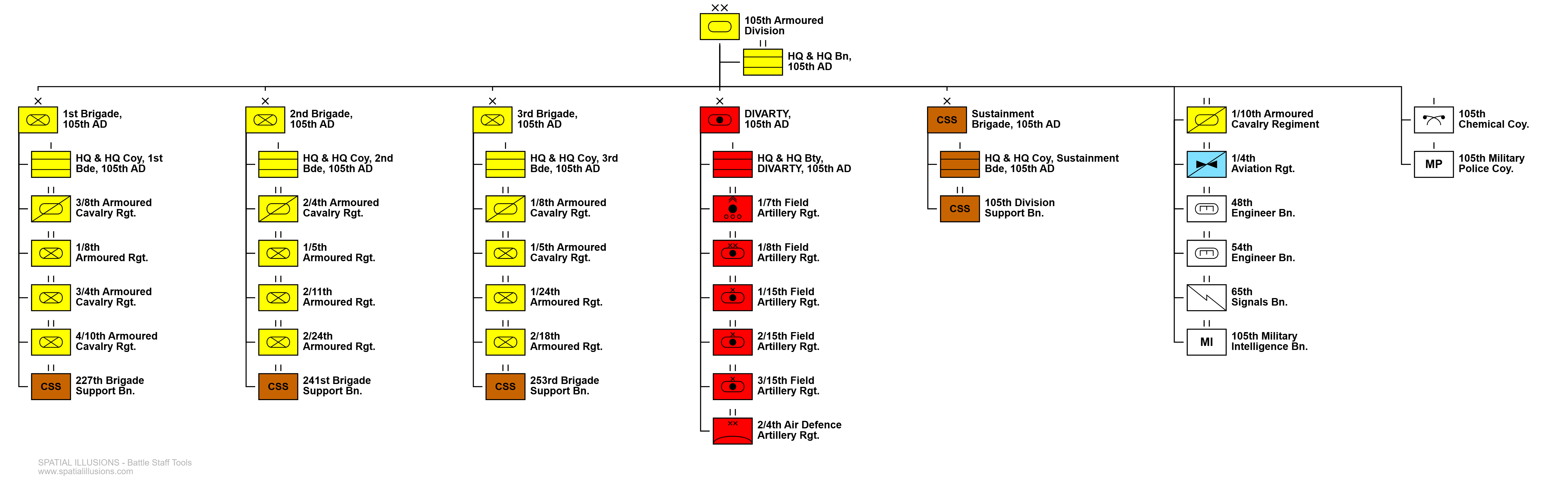
The 105th Armoured Division, formed in 1941 from the remnants of the 105th Armoured Brigade, is the premier heavy manoeuvre force of the CSGF. Seeing action throughout the Fascist War and remaining an active duty formation ever since, the Division has a long history and an illustrious record of deployment and combat. Today it forms the heaviest armoured force of the CSGF, organised around three Heavy Combined Arms Brigades, along with support and enablers. Each brigade under the division has an Armoured Cavalry Squadron, as well as three Heavy Combined Arms battalions (with Cavalry and Armour traditions). The Heavy Combined Arms Battalion has three manoeuvre companies, two Armour, one Mechanised Infantry. The Brigade Cavalry Squadrons have three ground Cavalry Troops, along with a Headquarters and Headquarters Troop. The Divisional Cavalry Squadron adds a Tank Troop and an Aviation Troop. In total, the division thus fields 400 tanks, making the 105th Armoured Division quite a heavy manoeuvre force. In terms of supporting assets, the Divisional Artillery has four 155mm Self-Propelled Howitzer Battalions, one assigned to provide general support to the Division, and the other three to provide direct support to the three brigades. The Divisional Artillery also has an MLRS Battalion to provide long range fires and saturation fires in the defence and attack, and an Air Defence Artillery battalion providing short to medium range air defence and counter-drone capability. The Divisional Cavalry Squadron provides reconnaissance and screening or covering capabilities for the division, with a small aviation component allowing it to act more independently in its role of covering the division and performing economy of force and reconnaissance. Furthermore, the division has a composite Aviation Battalion with recon attack and assault companies to support the division with organic aviation. The Divisional Sustainment Brigade provides logistical support to the Division, and additionally also controls the three Brigade Support Battalions that provide sustainment support for the three manoeuvre brigades. The Division also has two armoured combat engineer battalions, tasked with clearing obstacles, bridgelaying, and general mobility support. Combat engineers additionally provide demolition support for the manoeuvre formations. Then there are signals, military intelligence, CBRN defence, and military police units to round out the division's supporting elements.
The Division acts as the CSGF's heaviest manoeuvre force, and would serve as a heavy follow-on force for initial Scalvian assets in-theatre. At least one of the Division's three manoeuvre Brigades is maintained at high readiness to deploy at all times.
Kariste Division
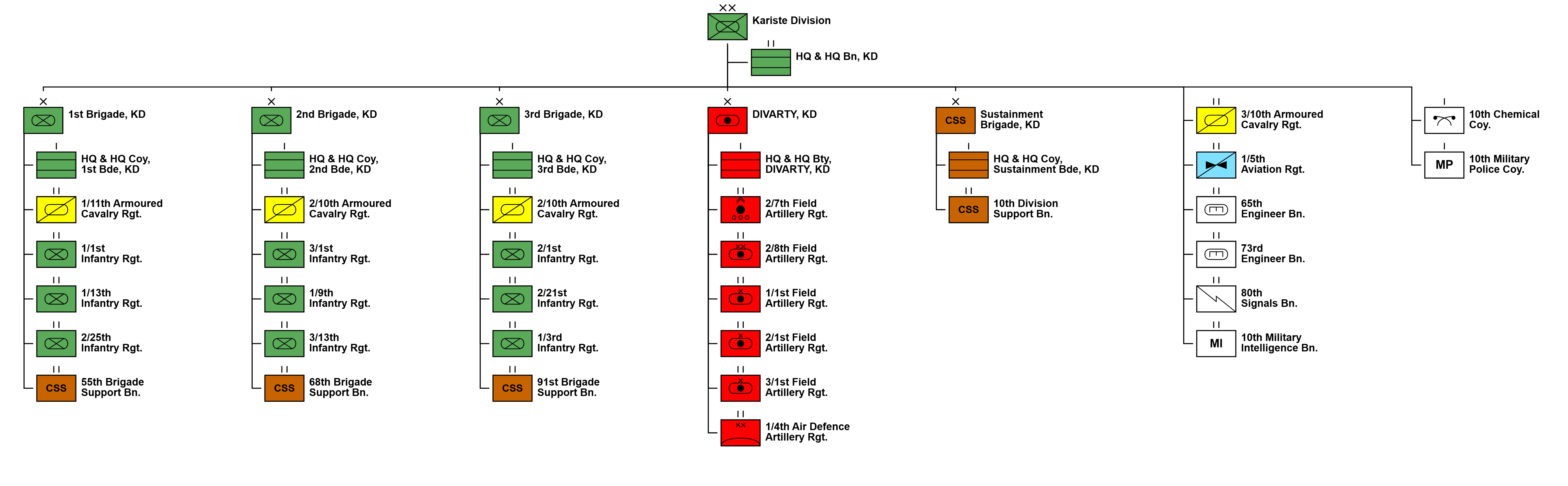
The Kariste Division is the CSGF's oldest continually existing division, formed as the Kariste Infantry Division in 1901. The Kariste Division, like the other CSGF formations, saw heavy action during the Fascist War, earning multiple Presidential Unit Citations for actions during the fighting. The Kariste Division was reformed into a mechanised division in 1963, and today remains a Heavy Mechanised Division. The force exists as the second heaviest division in the active CSGF, and would act as the primary heavy reserve of the CSGF, following the 105th Armoured Division into a theatre of operations. The structure of the division is broadly similar to that of the 105th Armoured Division, but instead organised around three Medium Combined Arms Brigades. The Medium Combined Arms Brigade is composed of a Cavalry Squadron and three Battalions with Infantry traditions, each with two Mechanised Infantry and one Armour Company. The Division therefore, with its cavalry squadrons, fields 256 tanks, combining for a total of 656 between the two active mechanised and armoured divisions. The divisional artillery is the same as in the 105th Armoured, with two general support battalions (one MLRS, one 155 SP), and three direct support battalions with 155mm SP Howitzers. The division has the same Combat Service and Support elements as the 105th Armoured Division.
The Division, as mentioned, acts as the primary armoured reserve of the active duty CSGF, able to provide a second heavily armoured division for major large scale combat operations, while providing somewhat greater infantry mass than the 105th Armoured Division. The Kariste Division's primary role in a LSCO, then, would be to provide the GFC with a heavy second echelon to give more options for heavy armoured offensive action.
7th Infantry Division
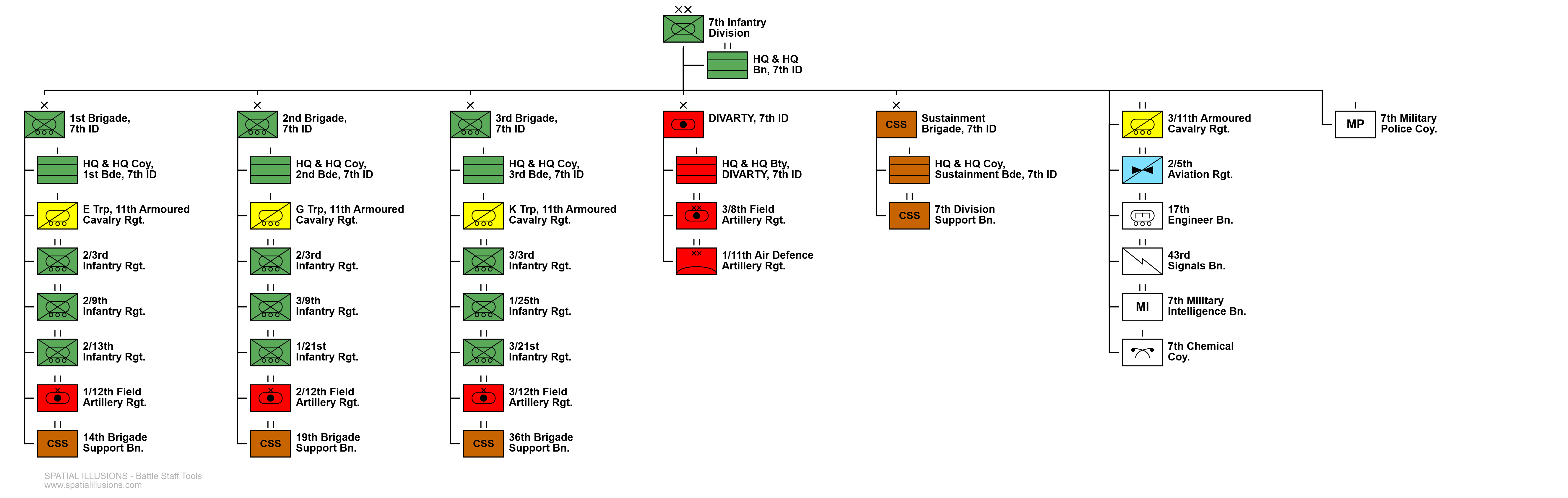
The 7th Infantry Division, formed in 1932, served in the Fascist War with distinction, before serving as part of the Allied Army of Occupation in Aria as an O-Series Infantry Division. Upon returning home in 1960, it was deactivated, before being reactivated in 1966 as an F-Series Infantry Division. It was mechanised in 1970, but lost its tanks in 1997, becoming a Wheeled Mechanised Division in 2002.
The Division is organised around three Wheeled Mechanised Brigades (also known just as Infantry Brigades) each having a Wheeled Armoured Cavalry Troop, and three Infantry Battalions. In addition, unlike in the Heavy Divisions, the DS Artillery Battalions are habitually attached to the three brigades, to enable them to act more independently, while administratively the battalions remain under the DIVARTY. Despite the Division in general being wheeled, the SP 155mm howitzers are not, being tracked platforms. This is something that the CSGF plans to address in the future via the procurement of a wheeled SP 155mm howitzer. The Division also lacks the MLRS battalion of the Heavy Divisions' artillery. Sustainment support is similar to Heavy Divisions. While the Wheeled Armoured Cavalry have somewhat less combat power than their tracked equivalents, they still possess considerable combat power with their new M8 WCFV more than capable of defending itself from enemy tanks with its ATGMs.
In terms of further combat support, the division possesses the same aviation support as the Heavy Divisions, but have less engineers, with just one battalion on wheeled vehicles, compared to two in the Heavy Divisions on tracked vehicles. The rest of the supporting elements are much the same as in the Heavy Divisions.
The 7th Infantry Division's role is to generate Mechanised Brigade Task Forces for less intensive, more independent operations in more distant theatrs, or to provide the Joint Force with a large mass of mobile bayonet strength for fighting in more complex terrain. In all, the force possesses considerable combat power, though certainly not as much as the heavy manoeuvre forces.
1st Airborne Division
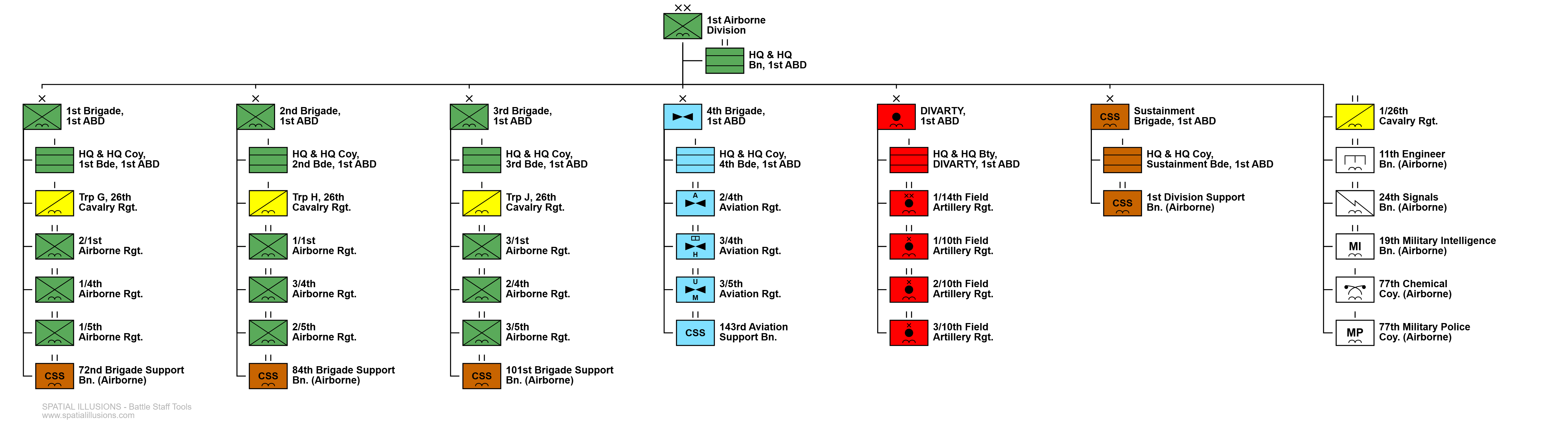
The 1st Airborne Division, formed in 1946 during the fires of the Fascist War in preparation for the Allies' great counteroffensive across the ATO, conducted numerous combat jumps during Operations Frogfoot and Brevity, then serving as a reserve of elite light infantry during the difficult campaign through Aria. They were not deactivated after the conclusion of the war, but were downsized. They were brigadised in 1966, and gained an organic 4th Brigade in 1974, providing the division with a large pool of organic airpower. In 1988, a Task Force primarily built around the 1st Brigade of the Division participated in the Gotmark War with distinction, carrying out a large scale combat jump.
Today, the division is organised around three Airborne Brigades, each with an Airborne Cavalry Troop and three Airborne Infantry Battalions. The airborne troops are lightly motorised in Infantry Section Vehicles and a small number of MRAPs. The 4th Brigade provides three Aviation Battalions; an Attack Battalion, a Heavy Transport Battalion, and an Assault Battalion. The Divisional Artillery is composed of four battalions, one 155mm towed Howitzer Battalion in general support of the division and three 105mm towed Howitzer Battalions providing close support to the brigades. All pieces are air droppable and transportable by heavy lift helicopters if necessary. All supporting assets of the Division are also on Jump Status, providing the CSGF's sole Airborne Military Police Company, for example.
The Division's role in a LCSO would be to conduct a Joint Forcible Entry Operation in the enemy's operational depth to open a large scale Scalvian offensive. This would further disorganise and complicate the enemy's defence against the offensive. Otherwise, the Division can generate high readiness, highly strategically mobile Brigade Task Forces for deployment to more distant theatres of operations, such as, for example, Gothis in 1988.
1st Armoured Cavalry Regiment
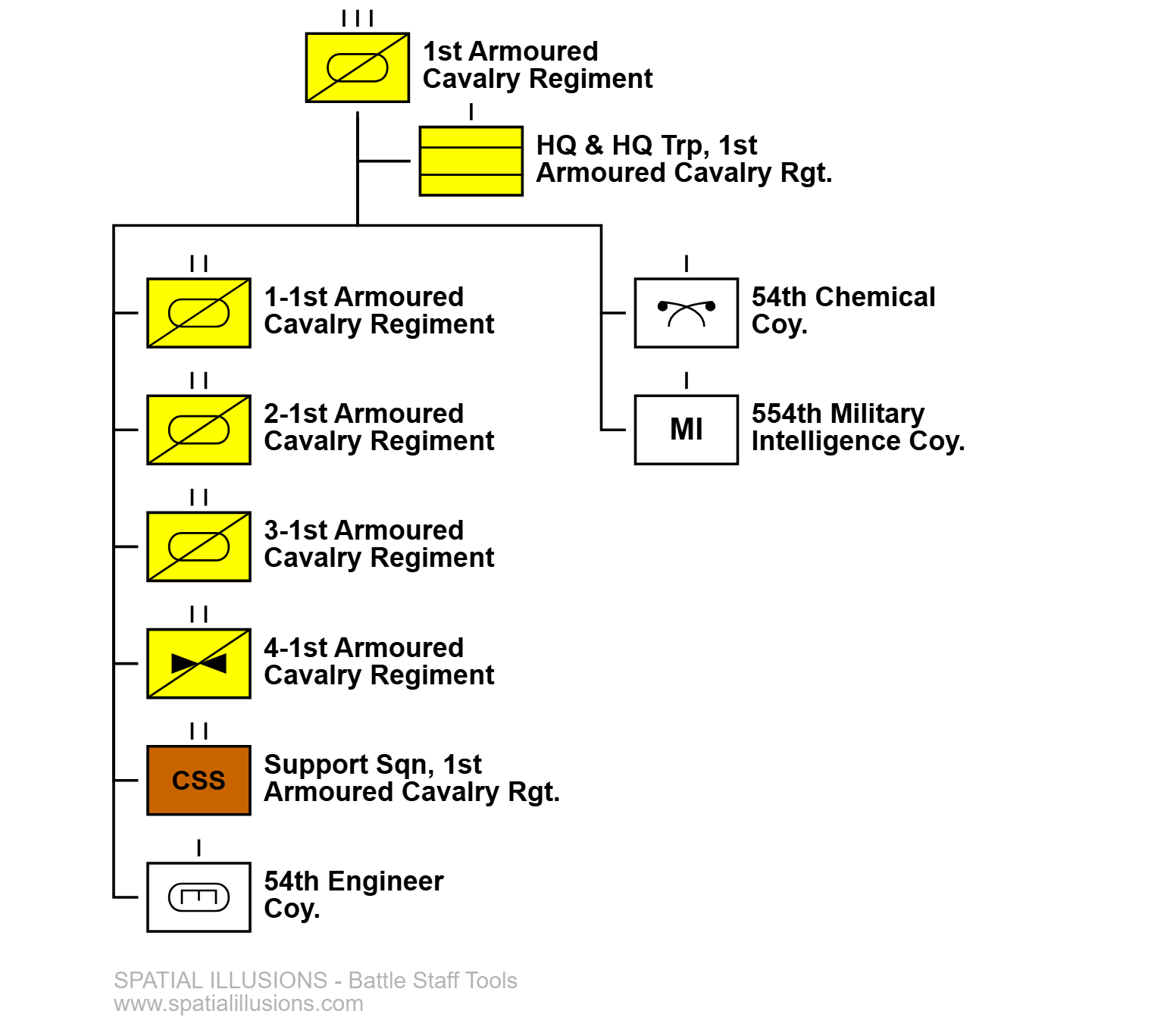
The 1st Armoured Cavalry Regiment was formed as a proper manoeuvre formation in 1964, with its 4th (Air Cavalry) Squadron participating in the Gotmark War as part of the 1st Brigade, 1st Airborne Division Task Force. Today, the 1st ACR is a self contained combat formation under the GFC.
The 1st ACR today consists of three Armoured Cavalry Squadrons, an Air Cavalry Squadron, a Support Squadron, a Combat Engineer Company, CBRN Defence Company, and Military Intelligence Company. Each Armoured Cavalry Squadron has four manoeuvre troops, three Cavalry Troops and a Tank Troop along with an eight-gun SP howitzer battery, with the guns usually spread out two pieces per troop, though they may be concentrated at the Squadron Commander's discretion, whereas the Air Cavalry Squadron consists of six line troops, five Recon Attack Troops, and an Aero-Rifle Troop. In total, the Regiment possesses 129 tanks, and 111 M6A3 Cavalry Fighting Vehicles.
The ACR's purpose is to provide the Joint Force with fresh information, reaction time and manoeuvre space, to preserve the Joint Force's combat power, restore command and control, facilitate movement, and when not performing other missions, to secure the rear area. To do this, they conduct reconnaissance, economy of force, and security missions. Reconnaissance is the most straightforward, their task is to answer unknowns that the Commander of the Joint Force needs answered, generally collecting information on the enemy such as their size, direction and rate of advance and so on, or the terrain. They might also seek out friendly forces when communications have been destroyed or jammed. Elements of the 1st ACR might be expected to re-establish command and control for a Division or the Joint Force. Economy of force missions are less straightforward -- at their core, EOF missions are when a smaller force does a task that would usually require a bigger force, which means it is not just one thing. This is generally to allow for resources to be prioritised to the main effort. Security operations protect a supported force, with the most important type for the ACR being the covering mission. Covering forces may be positioned in front of, to the flank, or to the rear of the main body to deny the enemy information about the main body, conduct reconnaissance along the main axis of advance, defeat, repel, or fix enemy forces, develop the situational understanding of the enemy, and exploit offensive opportunities until the main body is committed. To cover, the ACR conducts a mix of reconnaissance, screens, attacks, defensive, and delaying actions, as part of the Regimental cover mission. In a LSCO, the 1st ACR is the most readily deployable heavy armoured force, and would be the first major Scalvian combat formation to be deployed, followed by the 105th Armoured Division, and then the others.
Supporting Elements

The Joint Force has considerable supporting assets, including two Artillery Brigades to be committed at the discretion of the Joint Force Commander, a Military Police Brigade, providing a reserve of MPs for the Joint Force, the Special Operations Forces Command, providing the Joint Force with a highly capable special warfare component, the Intelligence and Deep Strike Command, combining fires, aviation, and intelligence assets to provide for the deep fires into the enemy's operational depth as foreseen by doctrine. In addition, the Theatre Support and Sustainment Command provides sustainment and engineering support for the entirety of the Joint Force.
Perhaps most noteworthy of these enablers are the Special Operations Forces Command (SOFCOM) and the Intelligence and Deep Strike Command.
SOFCOM, officially formed in 1985, provides the Joint Force with two Special Forces Groups primarily focused on unconventional warfare, reconnaissance, and limited direct action, while the 1st Ranger Group is a premier light infantry force specialising in direct action, such as airfield seizures, personnel recovery and so on, with an emphasis on high intensity short duration operations. The 1st Special Forces Aviation Group provides aviation support to the command, while the 1st Psychological Operations Group conducts information warfare operations in support of the Joint Force.
The Intelligence and Deep Strike Command combines intelligence and electronic warfare assets with long range fires and attack and recon aviation to facilitate deep strikes in the enemy's operational depth. The force consists of the 1st Aviation Brigade with three Attack Recon Battalions, the 29th Field Artillery Brigade with two MLRS Battalions and two Long Range One-Way Attack UAV Battalions, the 1st Cyber and Electronic Warfare Brigade, and two Military Intelligence Battalions. The EW and Intelligence assets provide information for the fires and aviation elements to act upon. The combined efforts of these assets, as well as the two other Artillery Brigades (at the discretion of the Commander of the Joint Force) and Tactical Air Power would cripple the enemy's rear area to allow for the manoeuvre forces to execute their aggressive offensive plans.
Conclusion
While the Scalvian Force Structure is clearly built primarily with a large scale war in the Aurorias in mind, the GFC retains the ability to deploy forces to crisis areas outside of the ATO. Overall, the existing force structure largely fits the doctrinal role of the CSGF, though the great question is of mass. Is the size of the force sufficient to fight the war Scalvia plans to fight? It is an open question, though the Commonwealth's Department of Defence says yes. Others, however, have criticised the assessment that the CSGF possesses the mass necessary to fight a major war against the likes of Sainaam or Aria. Scalvia's active duty force of four divisions is dwarfed by the much larger Arianese or Sainaamese force, though this is somewhat offset by the much lighter Militia, which provides the Joint Force with another four divisions. It must be kept in mind, however, that Scalvia does not plan to fight the war alone. Scalvia plans for it to fight alongside South Ethian and Hexastalian Forces. Though the CSMF is the largest of the three allied forces, the South Ethian and Hexastalian Forces can provide considerable mass to support the CSGF in its operations.
Overall, Scalvia's capability for completely independent action is probably somewhat limited, but it does exist, due to Scalvia's considerable airlift and sealift capabilities allowing it to deploy considerable forces anywhere within the ATO on relatively short notice. The Joint Force also has the ability to deploy considerable strength further afield, though requiring greater notice.
The Scalvian Ground Forces are on the high level composed of four manoeuvre divisions.
In Scalvian doctrine, the Division executes tasks for the Joint Force or the Corps. This means that Scalvia follows the division-centric, rather than brigade-centric model. This is informative of the war Scalvia expects to fight. Scalvia's military is optimised to conduct expeditionary large scale combat operations (LSCOs).
A note on doctrine and strategy
The Commonwealth of Scalvia Military Forces' core tasks as defined by the Ground Forces' Field Manual 5-0 "Multidomain Operations" are to defend the safety, security, sovereignty, and national interests of the Commonwealth of Scalvia, firstly by deterring war, and, if that fails, to fight and rapidly win a war away from Scalvian territory. This defines the strategic posture of the CSGF as an expeditionary warfare force. Scalvia's need for capabilities to execute expeditionary LSCOs is largely limited to the Aurorian Theatre of Operations, but it needs the capability to provide support to allies and defend Scalvian interests anywhere in the world. Of note, the Scalvian doctrinal approach is always to fight abroad whenever possible, to spare Scalvia itself from the widespread devastation of war. This comes as a consequence of the Commonwealth's experiences in the long and brutal Aurorian Fascist War, which saw widespread devastation across large areas of Scalvia. The core of Scalvia's strategic doctrine is thus to avoid another war on its own territory. As a consequence, the Commonwealth of Scalvia Ground Forces have a decidedly expeditionary and manoeuvrist character. Scalvian doctrine on both the defence and the attack emphasises close combined arms coordination and violence of action. Scalvia would fight a battle not just in the "main battle area" but would fight in the enemy's operational depth. Specifically, Scalvian doctrine calls for deep fires into the enemy's operational depth to disrupt command, control, and logistics, to delay and attrit the enemy's second and third echelons, and to suppress enemy enablers like tactical airpower and long range missile artillery. In the main battle area, Scalvian doctrine calls for speed, unpredictability and violence of action. On the defence, Scalvian forces fight a fluid, fighting retreat in order to buy time for follow-on forces, while launching frequent violent and unpredictable counterattacks to keep the enemy off balance. If giving up ground is not possible, Scalvian forces would attempt to force the enemy to attack prepared and scouted positions, with sighted artillery and air strike positions. There the enemy's attack would be broken and Scalvian forces would counterattack where possible. With the arrival of follow-on forces, and the enemy's first echelon defeated and second and third echelons attritted and disorganised, Scalvian forces would launch a violent and rapid offensive, always mobile and on the move.
This doctrine sees tactical airpower as a vital element of the fight, and thus very close cooperation with the Commonwealth of Scalvia Air Force is emphasised. If air support cannot be guaranteed, artillery and missile fires would be the only element, which would degrade the effectiveness of the doctrine but not eliminate it.
Structure of the Commonwealth of Scalvia Ground Forces Manoeuvre Forces
As mentioned previously, the forces are organised into four divisions, along with supporting assets. Let's look more in depth at the divisions and their supporting assets.
105th Armoured Division
The 105th Armoured Division, formed in 1941 from the remnants of the 105th Armoured Brigade, is the premier heavy manoeuvre force of the CSGF. Seeing action throughout the Fascist War and remaining an active duty formation ever since, the Division has a long history and an illustrious record of deployment and combat. Today it forms the heaviest armoured force of the CSGF, organised around three Heavy Combined Arms Brigades, along with support and enablers. Each brigade under the division has an Armoured Cavalry Squadron, as well as three Heavy Combined Arms battalions (with Cavalry and Armour traditions). The Heavy Combined Arms Battalion has three manoeuvre companies, two Armour, one Mechanised Infantry. The Brigade Cavalry Squadrons have three ground Cavalry Troops, along with a Headquarters and Headquarters Troop. The Divisional Cavalry Squadron adds a Tank Troop and an Aviation Troop. In total, the division thus fields 400 tanks, making the 105th Armoured Division quite a heavy manoeuvre force. In terms of supporting assets, the Divisional Artillery has four 155mm Self-Propelled Howitzer Battalions, one assigned to provide general support to the Division, and the other three to provide direct support to the three brigades. The Divisional Artillery also has an MLRS Battalion to provide long range fires and saturation fires in the defence and attack, and an Air Defence Artillery battalion providing short to medium range air defence and counter-drone capability. The Divisional Cavalry Squadron provides reconnaissance and screening or covering capabilities for the division, with a small aviation component allowing it to act more independently in its role of covering the division and performing economy of force and reconnaissance. Furthermore, the division has a composite Aviation Battalion with recon attack and assault companies to support the division with organic aviation. The Divisional Sustainment Brigade provides logistical support to the Division, and additionally also controls the three Brigade Support Battalions that provide sustainment support for the three manoeuvre brigades. The Division also has two armoured combat engineer battalions, tasked with clearing obstacles, bridgelaying, and general mobility support. Combat engineers additionally provide demolition support for the manoeuvre formations. Then there are signals, military intelligence, CBRN defence, and military police units to round out the division's supporting elements.
The Division acts as the CSGF's heaviest manoeuvre force, and would serve as a heavy follow-on force for initial Scalvian assets in-theatre. At least one of the Division's three manoeuvre Brigades is maintained at high readiness to deploy at all times.
Kariste Division
The Kariste Division is the CSGF's oldest continually existing division, formed as the Kariste Infantry Division in 1901. The Kariste Division, like the other CSGF formations, saw heavy action during the Fascist War, earning multiple Presidential Unit Citations for actions during the fighting. The Kariste Division was reformed into a mechanised division in 1963, and today remains a Heavy Mechanised Division. The force exists as the second heaviest division in the active CSGF, and would act as the primary heavy reserve of the CSGF, following the 105th Armoured Division into a theatre of operations. The structure of the division is broadly similar to that of the 105th Armoured Division, but instead organised around three Medium Combined Arms Brigades. The Medium Combined Arms Brigade is composed of a Cavalry Squadron and three Battalions with Infantry traditions, each with two Mechanised Infantry and one Armour Company. The Division therefore, with its cavalry squadrons, fields 256 tanks, combining for a total of 656 between the two active mechanised and armoured divisions. The divisional artillery is the same as in the 105th Armoured, with two general support battalions (one MLRS, one 155 SP), and three direct support battalions with 155mm SP Howitzers. The division has the same Combat Service and Support elements as the 105th Armoured Division.
The Division, as mentioned, acts as the primary armoured reserve of the active duty CSGF, able to provide a second heavily armoured division for major large scale combat operations, while providing somewhat greater infantry mass than the 105th Armoured Division. The Kariste Division's primary role in a LSCO, then, would be to provide the GFC with a heavy second echelon to give more options for heavy armoured offensive action.
7th Infantry Division
The 7th Infantry Division, formed in 1932, served in the Fascist War with distinction, before serving as part of the Allied Army of Occupation in Aria as an O-Series Infantry Division. Upon returning home in 1960, it was deactivated, before being reactivated in 1966 as an F-Series Infantry Division. It was mechanised in 1970, but lost its tanks in 1997, becoming a Wheeled Mechanised Division in 2002.
The Division is organised around three Wheeled Mechanised Brigades (also known just as Infantry Brigades) each having a Wheeled Armoured Cavalry Troop, and three Infantry Battalions. In addition, unlike in the Heavy Divisions, the DS Artillery Battalions are habitually attached to the three brigades, to enable them to act more independently, while administratively the battalions remain under the DIVARTY. Despite the Division in general being wheeled, the SP 155mm howitzers are not, being tracked platforms. This is something that the CSGF plans to address in the future via the procurement of a wheeled SP 155mm howitzer. The Division also lacks the MLRS battalion of the Heavy Divisions' artillery. Sustainment support is similar to Heavy Divisions. While the Wheeled Armoured Cavalry have somewhat less combat power than their tracked equivalents, they still possess considerable combat power with their new M8 WCFV more than capable of defending itself from enemy tanks with its ATGMs.
In terms of further combat support, the division possesses the same aviation support as the Heavy Divisions, but have less engineers, with just one battalion on wheeled vehicles, compared to two in the Heavy Divisions on tracked vehicles. The rest of the supporting elements are much the same as in the Heavy Divisions.
The 7th Infantry Division's role is to generate Mechanised Brigade Task Forces for less intensive, more independent operations in more distant theatrs, or to provide the Joint Force with a large mass of mobile bayonet strength for fighting in more complex terrain. In all, the force possesses considerable combat power, though certainly not as much as the heavy manoeuvre forces.
1st Airborne Division
The 1st Airborne Division, formed in 1946 during the fires of the Fascist War in preparation for the Allies' great counteroffensive across the ATO, conducted numerous combat jumps during Operations Frogfoot and Brevity, then serving as a reserve of elite light infantry during the difficult campaign through Aria. They were not deactivated after the conclusion of the war, but were downsized. They were brigadised in 1966, and gained an organic 4th Brigade in 1974, providing the division with a large pool of organic airpower. In 1988, a Task Force primarily built around the 1st Brigade of the Division participated in the Gotmark War with distinction, carrying out a large scale combat jump.
Today, the division is organised around three Airborne Brigades, each with an Airborne Cavalry Troop and three Airborne Infantry Battalions. The airborne troops are lightly motorised in Infantry Section Vehicles and a small number of MRAPs. The 4th Brigade provides three Aviation Battalions; an Attack Battalion, a Heavy Transport Battalion, and an Assault Battalion. The Divisional Artillery is composed of four battalions, one 155mm towed Howitzer Battalion in general support of the division and three 105mm towed Howitzer Battalions providing close support to the brigades. All pieces are air droppable and transportable by heavy lift helicopters if necessary. All supporting assets of the Division are also on Jump Status, providing the CSGF's sole Airborne Military Police Company, for example.
The Division's role in a LCSO would be to conduct a Joint Forcible Entry Operation in the enemy's operational depth to open a large scale Scalvian offensive. This would further disorganise and complicate the enemy's defence against the offensive. Otherwise, the Division can generate high readiness, highly strategically mobile Brigade Task Forces for deployment to more distant theatres of operations, such as, for example, Gothis in 1988.
1st Armoured Cavalry Regiment
The 1st Armoured Cavalry Regiment was formed as a proper manoeuvre formation in 1964, with its 4th (Air Cavalry) Squadron participating in the Gotmark War as part of the 1st Brigade, 1st Airborne Division Task Force. Today, the 1st ACR is a self contained combat formation under the GFC.
The 1st ACR today consists of three Armoured Cavalry Squadrons, an Air Cavalry Squadron, a Support Squadron, a Combat Engineer Company, CBRN Defence Company, and Military Intelligence Company. Each Armoured Cavalry Squadron has four manoeuvre troops, three Cavalry Troops and a Tank Troop along with an eight-gun SP howitzer battery, with the guns usually spread out two pieces per troop, though they may be concentrated at the Squadron Commander's discretion, whereas the Air Cavalry Squadron consists of six line troops, five Recon Attack Troops, and an Aero-Rifle Troop. In total, the Regiment possesses 129 tanks, and 111 M6A3 Cavalry Fighting Vehicles.
The ACR's purpose is to provide the Joint Force with fresh information, reaction time and manoeuvre space, to preserve the Joint Force's combat power, restore command and control, facilitate movement, and when not performing other missions, to secure the rear area. To do this, they conduct reconnaissance, economy of force, and security missions. Reconnaissance is the most straightforward, their task is to answer unknowns that the Commander of the Joint Force needs answered, generally collecting information on the enemy such as their size, direction and rate of advance and so on, or the terrain. They might also seek out friendly forces when communications have been destroyed or jammed. Elements of the 1st ACR might be expected to re-establish command and control for a Division or the Joint Force. Economy of force missions are less straightforward -- at their core, EOF missions are when a smaller force does a task that would usually require a bigger force, which means it is not just one thing. This is generally to allow for resources to be prioritised to the main effort. Security operations protect a supported force, with the most important type for the ACR being the covering mission. Covering forces may be positioned in front of, to the flank, or to the rear of the main body to deny the enemy information about the main body, conduct reconnaissance along the main axis of advance, defeat, repel, or fix enemy forces, develop the situational understanding of the enemy, and exploit offensive opportunities until the main body is committed. To cover, the ACR conducts a mix of reconnaissance, screens, attacks, defensive, and delaying actions, as part of the Regimental cover mission. In a LSCO, the 1st ACR is the most readily deployable heavy armoured force, and would be the first major Scalvian combat formation to be deployed, followed by the 105th Armoured Division, and then the others.
Supporting Elements
The Joint Force has considerable supporting assets, including two Artillery Brigades to be committed at the discretion of the Joint Force Commander, a Military Police Brigade, providing a reserve of MPs for the Joint Force, the Special Operations Forces Command, providing the Joint Force with a highly capable special warfare component, the Intelligence and Deep Strike Command, combining fires, aviation, and intelligence assets to provide for the deep fires into the enemy's operational depth as foreseen by doctrine. In addition, the Theatre Support and Sustainment Command provides sustainment and engineering support for the entirety of the Joint Force.
Perhaps most noteworthy of these enablers are the Special Operations Forces Command (SOFCOM) and the Intelligence and Deep Strike Command.
SOFCOM, officially formed in 1985, provides the Joint Force with two Special Forces Groups primarily focused on unconventional warfare, reconnaissance, and limited direct action, while the 1st Ranger Group is a premier light infantry force specialising in direct action, such as airfield seizures, personnel recovery and so on, with an emphasis on high intensity short duration operations. The 1st Special Forces Aviation Group provides aviation support to the command, while the 1st Psychological Operations Group conducts information warfare operations in support of the Joint Force.
The Intelligence and Deep Strike Command combines intelligence and electronic warfare assets with long range fires and attack and recon aviation to facilitate deep strikes in the enemy's operational depth. The force consists of the 1st Aviation Brigade with three Attack Recon Battalions, the 29th Field Artillery Brigade with two MLRS Battalions and two Long Range One-Way Attack UAV Battalions, the 1st Cyber and Electronic Warfare Brigade, and two Military Intelligence Battalions. The EW and Intelligence assets provide information for the fires and aviation elements to act upon. The combined efforts of these assets, as well as the two other Artillery Brigades (at the discretion of the Commander of the Joint Force) and Tactical Air Power would cripple the enemy's rear area to allow for the manoeuvre forces to execute their aggressive offensive plans.
Conclusion
While the Scalvian Force Structure is clearly built primarily with a large scale war in the Aurorias in mind, the GFC retains the ability to deploy forces to crisis areas outside of the ATO. Overall, the existing force structure largely fits the doctrinal role of the CSGF, though the great question is of mass. Is the size of the force sufficient to fight the war Scalvia plans to fight? It is an open question, though the Commonwealth's Department of Defence says yes. Others, however, have criticised the assessment that the CSGF possesses the mass necessary to fight a major war against the likes of Sainaam or Aria. Scalvia's active duty force of four divisions is dwarfed by the much larger Arianese or Sainaamese force, though this is somewhat offset by the much lighter Militia, which provides the Joint Force with another four divisions. It must be kept in mind, however, that Scalvia does not plan to fight the war alone. Scalvia plans for it to fight alongside South Ethian and Hexastalian Forces. Though the CSMF is the largest of the three allied forces, the South Ethian and Hexastalian Forces can provide considerable mass to support the CSGF in its operations.
Overall, Scalvia's capability for completely independent action is probably somewhat limited, but it does exist, due to Scalvia's considerable airlift and sealift capabilities allowing it to deploy considerable forces anywhere within the ATO on relatively short notice. The Joint Force also has the ability to deploy considerable strength further afield, though requiring greater notice.
Last edited:
Share: