• The NationStates server was subjected to a data breach. TNP Forums do NOT interact with the NS servers and remain secure. If you use the same password between the two sites, it is recommended you change your password.

Eutavian Community (EC)

Pronouns
he/his
TNP Nation
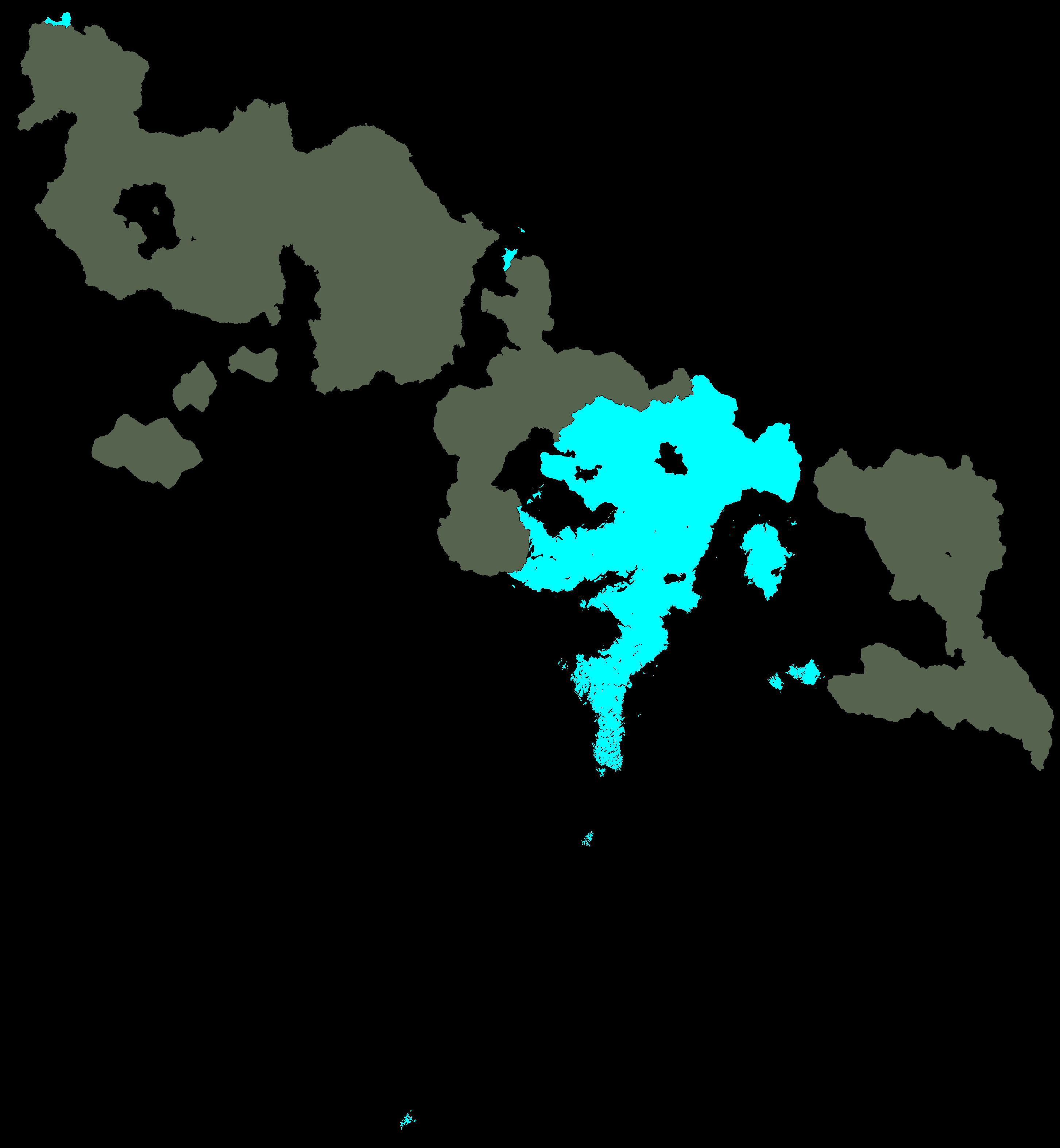
Alsatian Island
0f48y6.png
7szvkc.png


Eutavian Community (EC)
Atlish: Utavenish Fellowship (UF)
Älvdalsk: Etavniskt Samhälle (ES)
Beiran: Comunitat Eutaviana (CE)
Cumbric: Cymuned Eutafiaidd (CE)
Lyvenntic: Utævesuka Vyæra (UV)
Rosalian: Comunidade Eutaviana (CE)
Tyrrish: Coimhearsnachd Eòtmhialteach (CE)

Motto: Strength in unity

Member states: The Wardenate of Lyvenntia, the Commonwealth of Great Sutherland

DB64kFB.png


The forging of the EC
24294399522_fd700acf4b_b.jpg

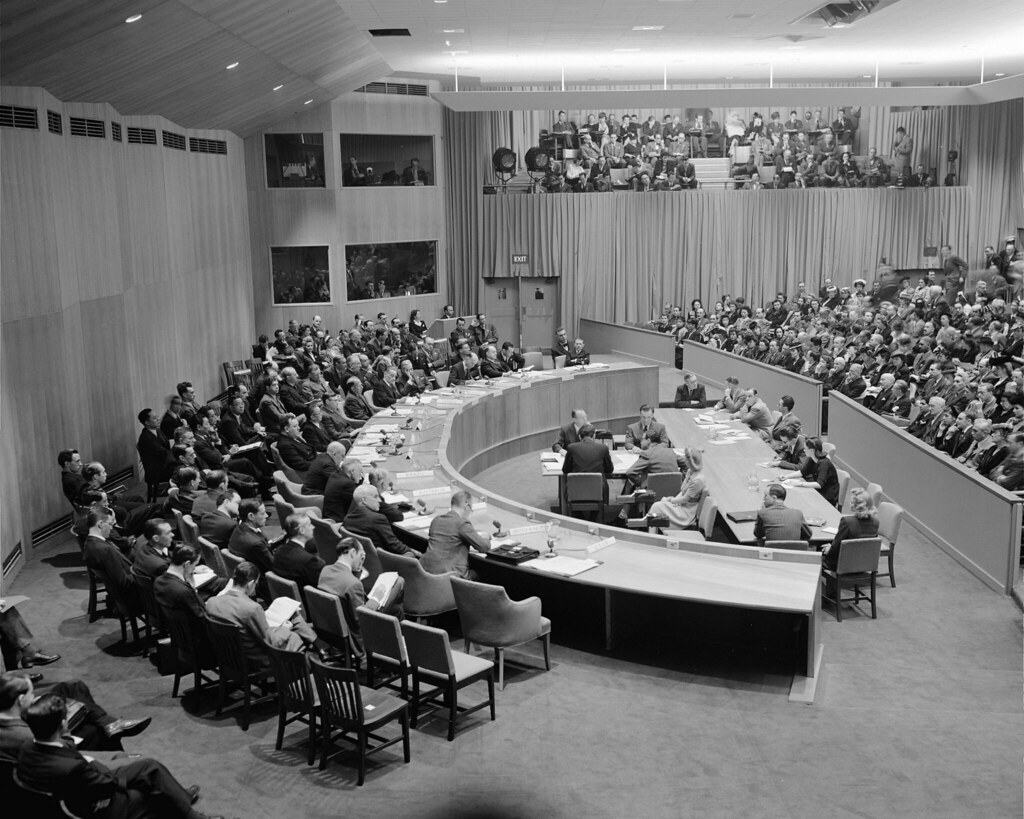
First meeting of the Eutavian Committee of Humanity in 1926 (right)

Eutavia rose from the ruin left by Godfred Roscow and his far-right, tyrannical style of government known internationally as Richeism in 1925. The URLS had splintered in its wake, while the classical democratic institutions which had sought to claim that their jurisdiction alone would protect individuals, and that there was no scope for individuals to hold the state to account on this benevolent basis, were left in total ruin.

The EC therefore began not on a whim, but out of an urgent, universally-accepted need to rebuild Eutavia stronger for future generations than those at the time had found it to be. While the Roscow era blatantly marked an abhorrent low point for human rights and democracy in what is now the EC, it would undo centuries-old precedent that had held the countries back, and usher in a radical reformation of the region.

Unsurprisingly, the first institutions to rise out of the ashes were those aimed at retributive and restorative justice in the wake of Richeist rule; the Eutavian Committee of Humanity sat for its first meeting on 2 January, 1926, and began the arduous task of not only determining what crimes had been committed over the past decade, but setting the precedent that crimes against humanity should be punished in the first place, especially in relation to the arbitrary punishment of Cumbric peoples and political prisoners.

After having tried the initial sixty defendants, of whom fifty-five were put to death, the Sutherlander government took the step forward to apply these new "crimes against humanity" and "crimes of aggression" against lower-to-mid level offenders in twenty comprehensive rounds of retributive justice, with the equally important decision by President Raynard Armstrong to defer to the ECH's judgments giving the EC its first real introduction into the political sphere. The foundations of the EC were now in place: a heavy focus on fundamental rights, and an apolitical yet radical approach to real justice.


1920px-BCEE_Place_de_Metz_Luxembourg_2013_02.JPG
The birth of a union
(left) Highhouse, the former home of the Eutavian Industrial and Manufacturing Community (EIMC)

The politicians of the age, however, knew that merely doling out retributive justice would not be enough to prevent another splintering and reactionary insurgence. Politicians from across the EC therefore gathered at Highhouse, south Týr, to discuss how further to interconnect the nations and regions that made up Sutherland and Lyvenntia.

The man who would go on to become the first EC Fortreader, Algar Mærson, told of a need to "shackle the two nations' productive capacities and futures to one another," such that an attempt to leverage one nation over another or to go to war internally would be "total folly." Preparations were therefore soon drawn up for the Eutavian Industrial and Manufacturing Community (EIMC), which was finalised with the Treaty of Yarkhill on 28 February, 1927. 28 February, as a result, is commemorated as Eutavia Day.

Highhouse was set up along with four other parallel institutions; the High Council (now the Great Council of Eutavia, or GCE), the Highmoot (which would become the union's elected legislature on EC matters), the High Court (HCEC) and the Eutavian Chancellery.

Within a few years of the EIMC being founded, the leaders of Sutherland and Lyvenntia met once again to sign the Treaty of Sunhaven on 8 June, 1929, which set up the South Calidian Treaty Organisation (SCTO). SCTO set out the establishment of a mutual defensive pact between Lyvenntia and Sutherland, as well as obligations to "maintain international and regional peace, security and fundamental, universal human dignities."

Eutavia in an unstable world
R.32ddf883d1fb38a069e7edcfa1e6ca93

The aftermath of TNRA bombings in the province of Franklin, mid-east Sutherland (right)
Inevitably, the rise of various forms of fascism throughout the world, as well as the bubbling over of tensions in Auroria to the north, as well as conflicts within Marais and Týr, intensified the movement for a united Eutavia.

The first move during the 1930s, following the establishment of the SCTO, was the establishment of a Eutavian Peacekeeping Command Organisation (EPCO), more often called the Peacekeepers, known often for the blue helmets and uniforms that Lyvenntian delegations used. EPCO was swiftly deployed in both Marais and Týr during the early 1930s to prevent insurgencies from advancing. While the decision to deploy active troops in Týr was controversial, it likely stabilised the region's conflict in the long-run, and EPCO played a key part in the détente which has since formed during the 1980s.

The Triviere Accords, which took place in 1933, expanded EPCO, as well as marking the start of a research and development boom in the region. Historians also have looked back at the Triviere Accords as the moment at which Eutavia's rearmament began, sparking the start of its arms production boom, during which it exported and granted large amounts of arms through a lend lease programme to the Allies in Auroria.

p0830csw-1676461394780.jpg
The formation of the Economic Union
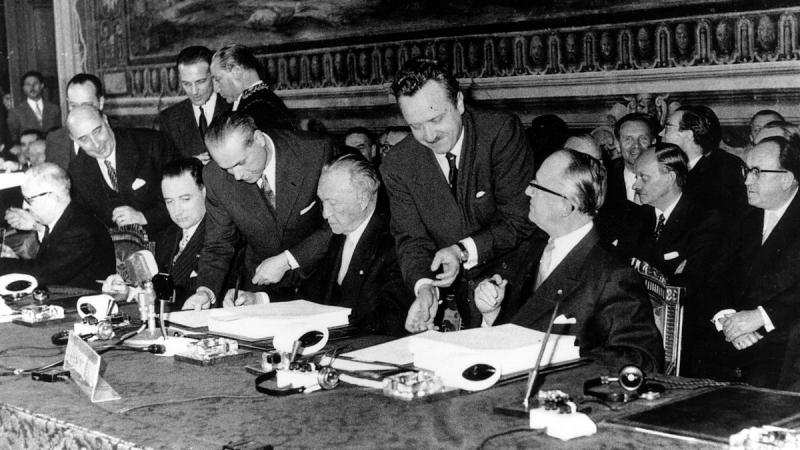
(left) Delegates from Sutherland and Lyvenntia sign the Treaty of Blencathra, founding the UEE

The Treaty of Blencathra, signed on 1 March, 1945, concurrently established four separate pillars of what would later become the Eutavian Community:
  • The Union of Eutavian Economies (UEE)
  • The Eutavian Social and Justice Council (ESJC)
  • The Eutavian Guardian Council (EGC)
  • The Eutavian Atomic Council (EAC), colloquially "Eutatom" (added 1952)
This established a common market (now a single market known as the Eutavian One Market, or E1M), as well as the fundamentals of freedom of movement for citizens, workers, goods, establishment and services, and the establishment of a common law system which de jure takes precedence over member states' law, supplemented by laws written by the Great Council and then amended by the Highmoot and approved by the Chancellery.

The founding of the Community
European_Parliament_-_Hemicycle.jpg

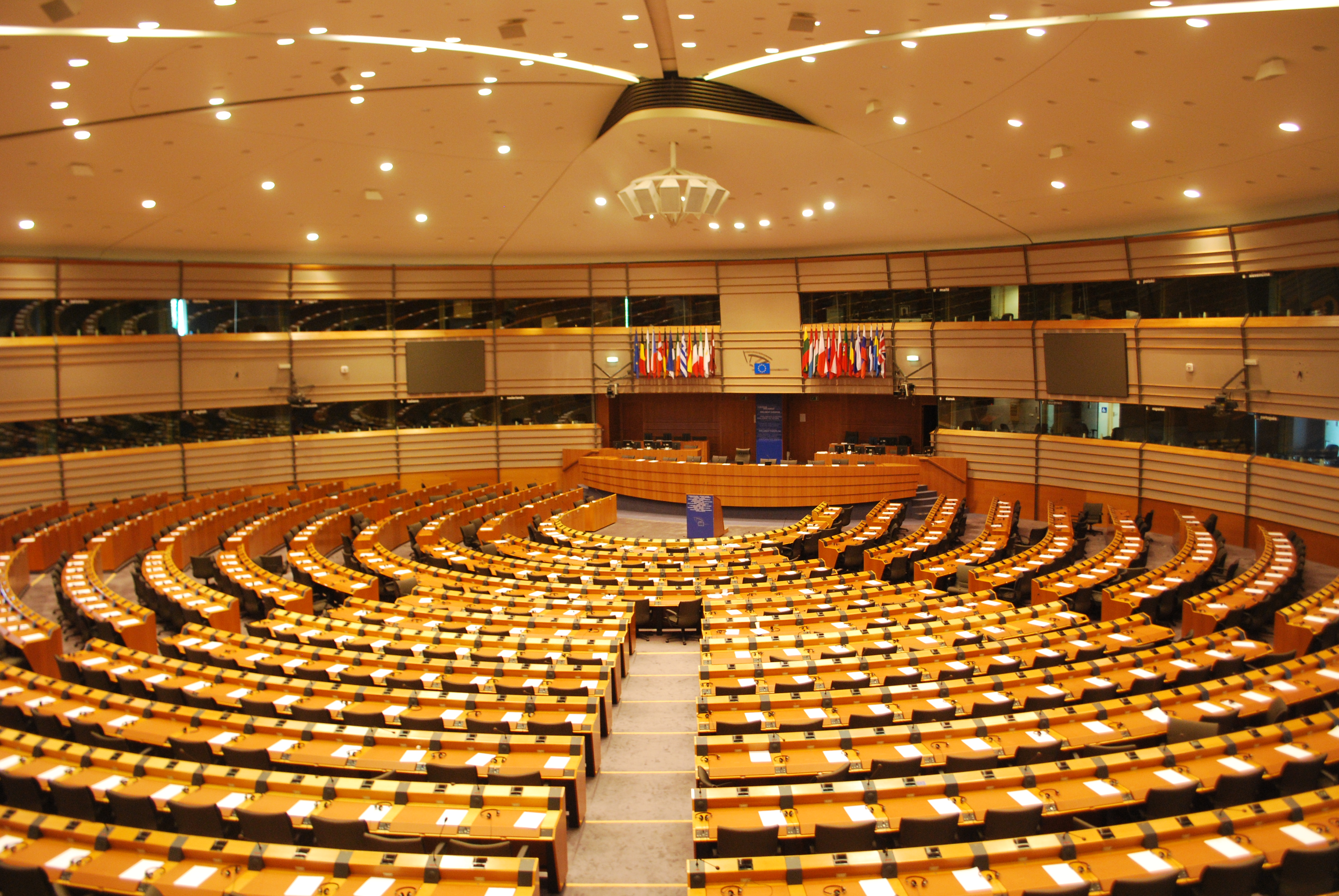
The Highmoot, where democratically-elected representatives from the member states amend and debate legislation to be put to the Chancellor of Eutavia (right)
In 1963, the High Minister of the Highmoot, Winston Albany, held a speech in which he called for a unity of the pillars into one Community:
"Our nations have countless institutions, countless co-operations, and possibly the most comprehensive continental framework for a sociopolitical and economic confederation that exists today. Yet, we have a bridge between our nations that lacks its keystone. I propose that we place the keystone at last, so we can connect our two nations in solidarity in perpetuity. That keystone, lords and ladies, is a Community."
With both national governments on board rapidly, incumbent Sutherlander President Archibald Fyles and his Lyvenntian counterpart signed the Treaty of Eamont on 6 April, 1964, which established that the continuity of the four pillars was in the form of a united Eutavian Community. As well as this, it transitioned the common market into a single market, established the EC Charter on the governance, rights and obligations of those within the Community, and set out the previously ad-hoc functions of the Community in explicit wording. Furthermore, the EC Charter has proven to be one of the world's most paramount and comprehensive human rights charters.

DB64kFB.png


Facts and figures on the EC:
R.ea4454a07f84115565ecc4536ca97766

(left) The EC's largest city, and the Sutherlander capital, Eamont
- Area: 1,385,585.27km²
- Population: ~266,000,000 (2024)
- GDP (nominal): ~14,000,000,000,000 IBU
- Main authoritative bodies:
  1. Eutavian Chancellery (EC)
  2. Great Council of Eutavia (GCE)
  3. Highmoot of Eutavia (HE)
  4. High Court of the Eutavian Community (HCEC)
  5. All-Eutavian Defence Agency (AEDA)
  6. Eutavian Space Agency (ESA)
- Currencies: Lyvenntian rook (LYR, Ɍ), Sutheran shilling (SSH, ʃ)
"A continent divided is no continent at all." - Oswald Morgan, Chancellor of Sutherland, 1977


Aims and principles of the Community within
20191121PHT67142-cl.jpg

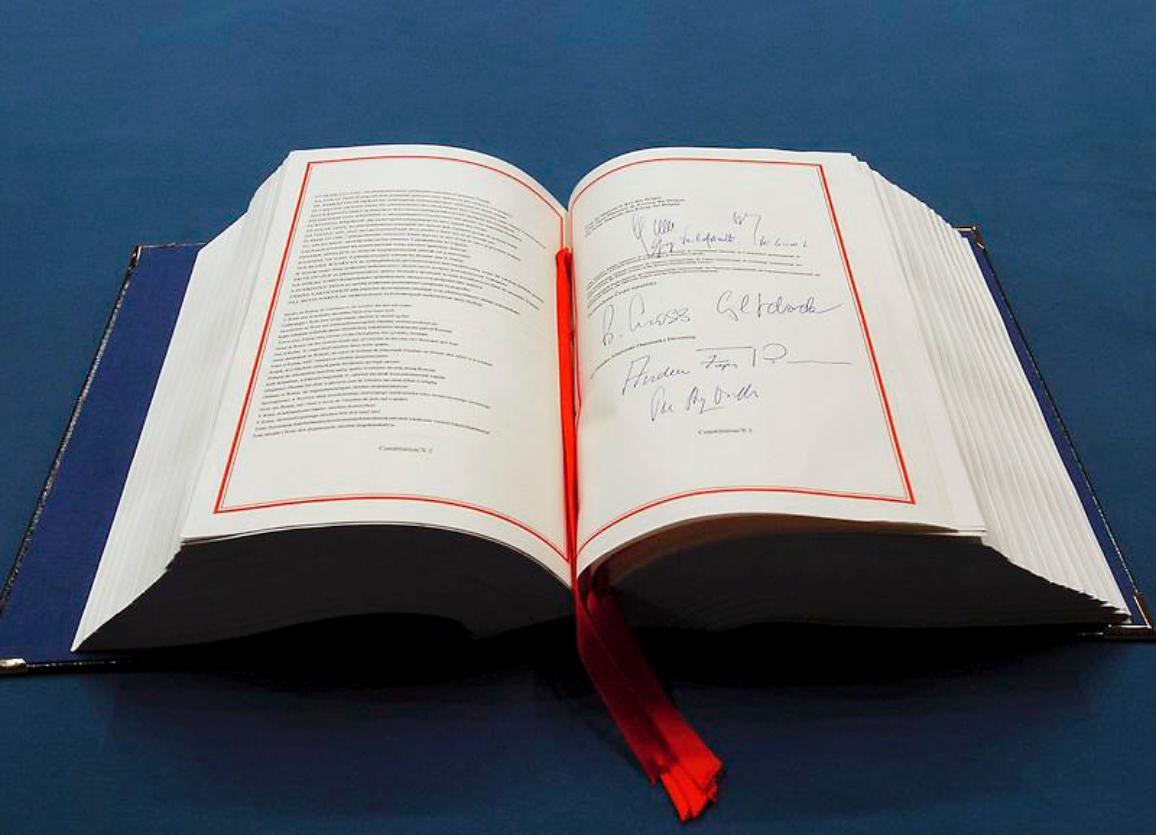
The EC Charter, which contains the fundamental rights, aims and functions of the Community (right)
The Community, as part of the EC Charter and a number of subsequent treaties, has numerous stated aims and principles that underpin its institutions, member states' actions, and military and scientific endeavours.

Internally, the EC's aims are as follows.

  • Preserve peace in its fullest form, mitigating all forms of conflict between its citizens and authorities to whatever extent is realistically possible,
  • Facilitate an open, free market, which can exploit economies of scale and leverage a far stronger hand in the global economy for the equitable benefit of all of its citizens,
  • Offer its citizens the freedoms uncovered by proportionate security under the accountable rule of fair law,
  • Not merely promote scientific and technological progress for humanity and the good of fair, democratic societies, but to fiercely lead it,
  • Protect, preserve and respect the environments endowed on the member states and their folks by the good of Eras,
  • Eliminate discrimination based on any protected characteristic, and constrain socioeconomic inequity to ensure equality of opportunity and equity of outcome,
  • Guard the rights of groups historically marginalised, persecuted and failed by the state, society and culture, by recognising the free equality of religion and race under secular, representative law, preservation of the rights and autonomies of the child, and active equality of man and woman in all spheres of public and private society...
OIP.0WEm0R5OaFOeUvK8lc22TgHaEK
The logo of the High Court of Eutavia (HCE) in Monreial, Beira, north-east Sutherland (right)

  • Achieve and maintain sustainable growth for all nations, regions and citizens to access based upon a fairly regulated, productive economy of full employment, promoting the principles of equity of outcome, high-quality accessible education, and the rights of workers to move freely within the Community and collectively assemble,
  • Deepen our social, cultural, economic and political connections inclusively within and without individual localities, regions and member states to enrich our lives, cultures and economies for the better,
  • Take appropriate and proportionate measures at the external borders of the Community to balance the needs of those seeking entrance, refuge or establishment within, the abilities of those within to provide, and the preservation and proliferation of Community values.

Aims and principles of the Community beyond
milky-way-rising-over-the-earths-horizon.jpg
(left) The logo for the webpage pillarsofeutavia.ec

The Community maintains a number of aims and principles with regard to the world.
  • Uphold, promote and proliferate its values and interests for the common good of both the world and the Community citizens,
  • Act in the interest of humanitarianism, and contribute to protecting the interest of world citizens, as well as their freedom from fundamental wrongs and insecurities,
  • Actively promote solidarity and mutual respect among peoples, free and fair trade, eradication of poverty and gross inequality, and the protection of human rights,​
  • Collaborate in good faith with our partners and counterparts across the world,​
  • Maintain the Community's endeavours of discovery towards what is above the sky, beneath the oceans, beneath the surface of earth and at the smallest scales,​
  • Safeguard the vulnerable and universally enforce universal, irrevocable duties to prevent genocide, slavery, ethnic cleansing, apartheid, extermination, rape and sexual slavery, or forced prostitution, or forced pregnancy, unjust deportation or displacement or transfer of a population, forced abortion or sterilisation, targeted group persecution, enforced disappearance, and other acts constituting great unjustifiable suffering.​

Key persons of the Community
1650828248582

Armand Galcerán, Chancellor of Eutavia (2019-present) with Chancellor Allister Ramsay of Sutherland (right)


Chancellor of Eutavia: Armand Galcerán (Sutherland, 2021-present, term limited to 27.02.2029)
High Councillor of Eutavia: Kou-Solen Faýlen (Lyvenntia, 2025-2026)
High Minister of Eutavia: Dagny Rickardson (Sutherland, 2022-present, Highmoot term ends 07.11.2025)
Foredeemer of the High Court of Eutavia: Godwin Redbridge (Sutherland, age limit reached 06.06.2036)
Heads of the Eutavian Security Council: Elsith Griffiths and Kyækou Hýaurii (Sutherland and Lyvenntia, both 2024-2027)
Directors of the Eutavian Criminal Investigation Command: Xosé Antón Novoa and Hyasari Skoræ (Sutherland and Lyvenntia, both 2025-2029)
High Representative for Foreign Affairs in Eutavia: Lumi Nælysu (Lyvenntia, 2021-2026)
High Representative for International Trade Affairs in Eutavia: Everett Morgan (Sutherland, 2021-2026)
High Representative for Scientific and Astronomical Affairs in Eutavia: Kemi Hýrenii
(Lyvenntia, 2021-2026)
List of Councilmen: TBC


DB64kFB.png
 
Last edited:
Eutavian Space Station ("Outpost")

ABC.png

The Eutavian Space Station (Atlish: Utævnsgeimstand, Lyvenntic: Utævesuka Avarrus Æsma; nicknamed Outpost) is a space station assembled and maintained at low Eras orbit (~400km above the surface) by the Eutavian Space Agency; it primarily serves as a platform for conducting experiments in microgravity, and researching the space environment, and more broad scientific innovation and research. It is permanently crewed by between four and six crew as of 2025, and has been gradually expanded from the launch of its first module in 2020, as part of the Eutavian Community's Moonshot programme, costing a total of roughly ʃ18bn/Ɍ21bn (IBU 13bn) since the ESS's launch; it is estimated that the cost of the full project, from Vidar to end of life, could be around ʃ45-55bn/Ɍ50-65bn (60-90bn IBU). Its second module was attached in 2022, and its third in 2023. It is one of the most ambitious projects of the Eutavian Community.

250415093822422-2025-nasalocker.jpg
Over 1,000 missions are (initially) approved by the ESA during its ten-to-fifteen year service life, with space life sciences and biotechnology, agriculture in space, microgravity, material space science, fundamental physics, and other modularised or specialised experiments being housed and facilitated by the apparatus onboard. The ESA's core goals with the ESS are multifaceted - reasons include technology for the rendezvous of spacecraft, long-term human operations in orbit, regenerative life support technologies on spacecraft, and autonomous technologies for cargo and fuel supply. There is also speculation that it will be used as the platform for next-generation space vehicles in orbit, and technology for deep-space exploration. The ESA has not ruled out future private investment or "space tourism" opportunities, however the government of Sutherland in 2026 commented that it "is not currently approaching any entities regarding these goals."

The ESS has led to breakthroughs in Alzheimer's and dementia research, study into endothelial cancer cells, long-term adaptation to space environments with regard to exercise and diet, microbial mutation, and synthetic human tissue engineering, as well as the study of quantum mechanics on an atomic level, dark matter detection methods, and "cool" flames. It has also developed greater water recycling and life-support systems, DNA sequencing, and a wide variety of food production, with even lightning detection possible.

The ESS commonly runs "space lectures" (as pictured on right) and educational activities to children in Eutavia and the rest of the world, with question-and-answer activities conducted, as well as school research projects. There is also amateur radio (ARESS), which allows students across the world to talk directly with crew members aboard the Eutavian Space Station, with the goal of inspiring people to careers in science, astronomy, technology, engineering, mathematics, and more.

There have been ten missions since the launch of Outpost, with the current crew - who arrived with mission Valland M-23 on 7 December 2025 - being Vera Alvares, Godfrey Bell, and Kouya Lyski; there have been a total of thirty astronauts aboard the ESS over its operational history, with a further fifteen taking part in the Vidar and Njord predecessor missions. The ESA has speculated that the vessel could remain operational from its launch for 15 years (roughly late 2035).

The ESS (Outpost) is visible from Eras with the naked eye, for the few hours before sunrise and after sunset.

History
Background (1990s-2000s)

Tianzhou-1_and_Tiangong-2_rendering.jpg

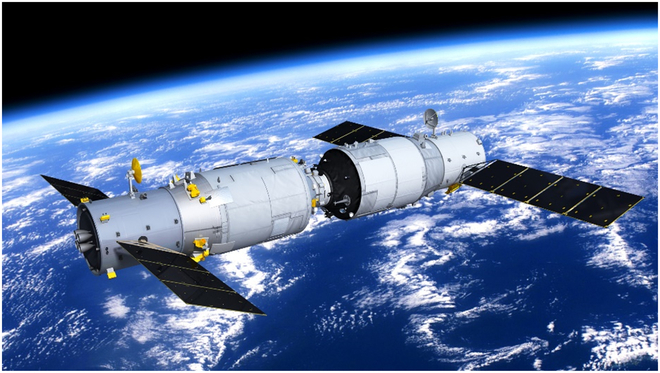
(right) Njord, the experimental space station launched in 2016 and decommissioned in 2019 in advance of the launch of Outpost's first module

The Moonshot programme was first conceived at the Third Millennium Conference of Eutavia (3000CE) in 1999, where it was determined that Sutherland and Lyvenntia would step forward to become world leaders in space technology, research, and exploration, following a relative lull after its focus on research and steps up to the manned moon mission to Yama in 1989. This programme gradually came to include plans for an unmanned Eutavian moon mission (becoming the Yama moon mission involving the Avançado lunar probe completed in 2019), Eutavian moon mission (which would become the Brigantia mission due to launch to Beiras in August 2026), research projects on Ethra and exploration of possible life and water, and plans for a "permanent space outpost", over the following generation.

In 2004, the Eutavian Space Agency announced its plans to complete a "transition-stage" space module, which would be crewed for "a few years" and whose intention it was primarily to investigate and apply the technologies and research necessary for the eventual permanent station to be possible. In particular, microgravity research was the focus of this module from the start; it was given the name Vidar, after the Norse god, as part of its brief description and design release on New Year's Day 2008. An ESA spokesman clarified the Vidar's two core missions as "foundations to the eventual, permanent space station - especially with regards to its technologies - and groundbreaking microgravity experiments conducted by Eutavian crew".

Vidar (2009-2015)
The ESA initially organised its launch date to be in early 2008, however delays to construction meant that the launch of Vidar only took place in April 2009 - with millions of Eutavians watching its launch live on SBS and UTA - following extensive testing. Vidar had a mass of roughly eight and a half thousand kilogrammes, was just nearly eleven metres in length, and had a pressurised habitable volume of roughly fifteen cubic metres. With a crew of three, one of the crew was assigned sleeping quarters in the docked Valland spacecraft rather than within the ship, to save on space; this was also true for kitchen and bathroom facilities on the four missions that the Vidar conducted over its lifespan. In June 2009, the first-ever Eutavian autonomous orbital docking was conducted with the Valland M-4 spacecraft, following its successful orbital manoeuvres.

Preparations began for the first crew mission to the Vidar in July 2009, leading to the eventual selection of Martha Bassett, Francisco Nunes Mendes, and Hyasami Øren for the inaugural crew (Expedition V-1), with internal checks for toxic gas conducted in this month. The Valland M-4 successfully took off from Kap tal-Punent, Mellieħa, Overseas Sutherland on 8 November 2009, and docked with the Vidar two days later. The expedition took place over eleven days, and validated the ESA's life support mechanisms, while successful rendezvous and docking (both autonomous and manual) were performed. Francisco Nunes Mendes began his own organisation, Our Sky, in 2012 to encourage education about astronomy and space, and to encourage people to "take the leap" into becoming astronauts at schools.

In 2010, the ESA confirmed its next space station, which would develop refueling and research upgrades into its scientific payload, with the capacity for longer expeditions. It gave it the name Njord - this time of a seafarer Norse god - and planned for its launch in 2013-2014.

Sutherland-Sutherland-Sutherland.png
(left) Sutherlander astronaut Alastair MacKay on the V-2 expedition, 17 January 2011

A further expedition (V-2) took place from 13-23 January 2011, with two further Lyvenntian and one further Sutherlander astronauts taking part in cutting-edge research, until the planned decommissioning date of 30 November, 2011 arrived. The ESA entered Vidar into its end-phase, during which its orbit gradually decayed, in order to research the longevity of its technology and instruments; the Vidar eventually stopped being capable of viable communication with Eutavian Space Agency ground control at the Uumæra SAR, Lyvenntia, on 2 June 2013, leading to the official end of the mission ten days later. Its orbit gradually decayed over the following 18 months, until it made an uncontrolled entry in the Meterran Sea on 9 January 2015.

Njord (2016-2019)
The Njord was subject to some significant delays due to technical issues, leading to its eventual launch being dated from its initial late-2013 to early-2014 beyond the re-entry of the Vidar, with its launch taking place from Kap tal-Punent on 3 February, 2016. The Njord, unlike the Vidar, was capable of longer stays, greater scientific research, and housed kitchen and bathroom facilities integrated rather than relying on the docked spacecraft. The ESA defined the mission's parameters as "making the step from basic docking and life support mechanisms to a sustainable, intermediate, well-operating station", and the (eventual) success of the Njord led to an acceleration of its programme for the eventual space station, which it now called Outpost. The Njord was plagued with computer issues and software faults during its service, famously frustrating astronaut Rykard Ivness so much that he swore on live TV before the watershed; these failures became so routine, with other technical issues such as heating and the slightly below-optimal launch orbit curtailing the mission by roughly 6 months, that the ESA briefly considered a third temporary space station rather than going straight to the Outpost. Following these frustrations, the ESA investigated its under-construction technology for the ESS itself, while leaks from within the Sutherlander government showed frustrations with these delays - Ramsay's Reeve for Higher Education and Research in 2017 is said to have predicted that a third vessel due to Njord's issues would delay the ESS by "five, maybe even ten years", and lobbied against it in favour of a "software division" specifically to dedicate manpower to the problem, possibly to prevent the failure or any expense being weaponised by the Againsthood.

During the 33-day mission allocated for Expedition N-1 in November 2016 (which was, due to Njord's delays, the first manned mission by Sutherland in five years), conducted scientific and technical experiments included:
- testing the physiological effects of weightlessness;
- tests on human-machine collaboration on in-orbit maintenance technology;
- progress on the gamma-ray burst polarimeter; and
- achievements on researching the "space cold atomic clock".
On 30 March, 2017, a cargo ship successfully docked with Njord and performed refuelling, with three further dockings (the latter of which took place in just 6 hours, not 48) taking place during the life service of the station.

ABC.png
(right) An SBS plan of the Outpost space station, dated from around the time of the launch of the core module in late 2020

A further two expeditions took place, with experiments including the successful release of an accompanying satellite, until the Njord was lowered from its orbit of around 370km down to 280km in August 2018, with the ESA confirming in response to speculation that this was indicative of the Njord's decommissioning - the Outpost was scheduled to have its first launch after the launch and completion of the Avançado unmanned lunar mission to Yama the following year, with the ESA setting a date of between late-2019 and early-2020 two years earlier. The Njord then returned to its previous orbit for a following eleven months, until its deorbit and re-entry in July 2019.

Outpost (2020-present)
The ESA named the Eutavian Space Station "Outpost" in a 2017 release, however had been planning its full construction as early as the success of the Vidar in the early-to-mid 2010s. Other candidate names included "Wayfarer", "Wanderer", and "Odin". A more comprehensive reveal of Outpost designs was unveiled at Airshow Eamont in 2019 (Æ'19), showing the mockup for the core module and planning the release "within eighteen months".

Following the Avançado unmanned lunar mission to Yama in 2019, the ESA began preparations for the launch of the core module, then named Frea. Frea has over thrice the pressurised habitable volume of the relatively-similar scaled Vidar and Njord at roughly fifty cubic metres, which comprises around forty-percent of its total volume. It has the integrated structure for three crew to sleep, live, and cook, while providing guidance, navigation, and orientation control for the entire station. Three sections were unveiled for the Frea at the 2019 Airshow - the habitable, non-habitable, and docking quarters. The station has a large robotic modern arm with seven different axes of motion to crawl in order to facilitate the movement of subsequent modules (as would be necessary in 2023 and will prove necessary later in 2026), and while it also houses computers, ground communications equipment, scientific equipment and apparatus, fire and air control, while the living quarters house a kitchen and a toilet. Electrical power, as with the rest of the Outpost, is provided by photovoltaic solar panels, which Sutherland is well-known for production of. There are 4 ion engines for propulsion, while the vessel receives refuelling in order to enable it to counteract atmospheric drag. The Frea has the capacity to dock with four other modules in total.

Tianhe_core_module_mockup_at_CSTM_03.jpg
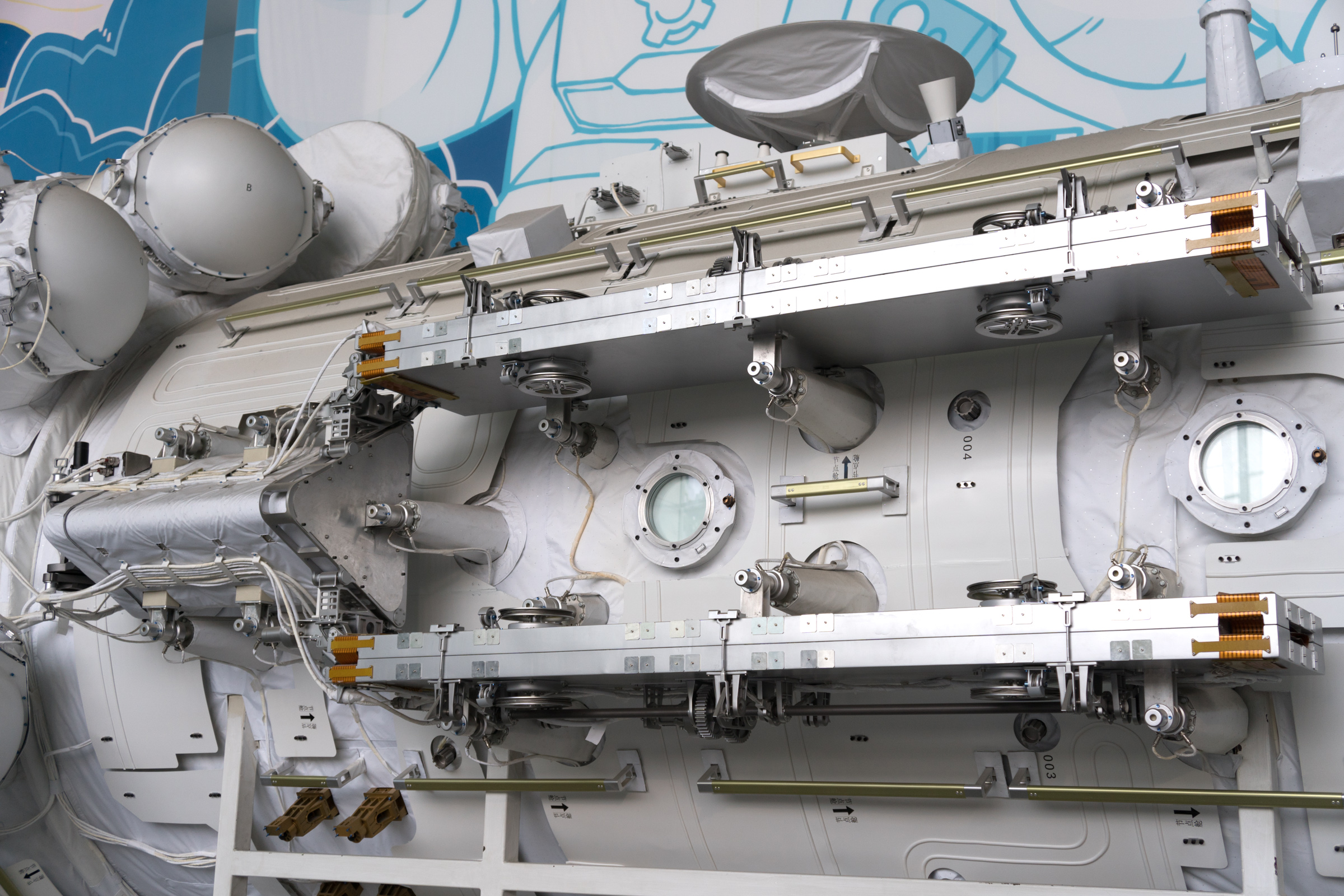
(left) The ESS "Frea" module on display at Airshow Eamont 2019; the photograph shows folded photovoltaic solar panels

The ESA announced that the Frea model was "ready for service into the 2030s" prior to its launch in 2020, while stated that of the models it had considered, the Outpost would be the "most flexible to future missions and directives for the ESS."

Attached to a Frelsedom F1 launch vehicle, the Frea was launched on the morning of 5 September 2020, somewhat later than scheduled. The Frelsedom F1 re-entered in a controlled re-entry over the Central Ocean, while the Frea was successfully launched into orbit. The first docking took place within a month, with a subsequent Valland M-14 bringing the first crew of three (Aubrey Marland, Lumi Skoræ, Hysen Klarin) to the Frea; all but one of its dockings have proven successful, with one in 2024 made a partial failure due to damage from space debris. The docked Valland M-21 was eventually launched into orbit with cargo but as an unmanned mission, six months late.

The subsequent modules launched in late 2022 and late 2023 respectively provided greater avionics and life-supporting capacity, internal experiment racks, external platforms for life-supporting research, a dedicated airlock for EVA (extra-vehicular activities) to allow the temporary capabilities on the Frea to be replaced, as well as additional apparatus for microgravity research and a cargo airlock between the interior and exterior for transferring payloads. This has allowed it to have a total capacity of six during its handovers, however it typically has a capacity of three crew. After two missions lasting ninety days, every mission since has lasted roughly half a year (~180 days). There have been ten missions since the launch of Outpost, with the current crew - who arrived with mission Valland M-23 on 7 December 2025 - being Vera Alvares, Godfrey Bell, and Kouya Lyski. The ESA has speculated that the vessel could remain operational from its launch for 15 years (roughly late 2035).
 
Last edited:
Back
Top