Sepadivjdje - Instant Encyclopedia [OPEN]

Ashita

born under a bad sign with a blue moon in your eye
-
-
-
TNP Nation
Pozolanni
1e4voc.png


Imagine an Eras where every single person has instantaneous access to the sum of all knowledge. Information the doyennes of ancient empires would kill for, at your fingertips. — Gellhard Malek, Chair of the Sepadimedia Foundation

Welcome to Sepadivjdje,
the Instant Encyclopedia that anyone can read and edit!
Our mission has been to benefit humanity by serving as a respository for all of human knowledge on history, science, math, culture, and more! Hosted by the Sepadimedia Foundation, Sepadivjdje composed of freely viewable and freely editable content.

Sepadivjdje, our name, reflects this mission. A Kalivese-language neologism, sepadivjdje is a combination of the words sepadi and vjdje, which, in Mercanti, translate to "instantaneous" and "knowledge," respectively.

All content on Sepadivjdje, from text, data, references, and images, have all been meticulously composed and edited by a corps of volunteers from across the globe. Sepadivjdje's software makes it easy to instantly improve content, add quality information, remove misinformation, and fix errors and vandalism. As Sepadivjdje is continually updated, encyclopedic articles on major news events can appear within seconds. Since its inception in 1996, Sepadivjdje has grown into the world's largest reference website, attracting over a billion visitors each month.

For over 29 years, editors have volunteered their time and talents to create history's most comprehensive encyclopedia while providing references and other resources to researchers worldwide.


Visit our sister projects!​

Sepadimedia Commons - Free and open-source media repository
Sepadiqiþan (Sepadiquotes) - Free compendium of sourced quotations from notable people and creative works
Sepadigrantha (Sepadibooks) - Free and open-source library of public domain textbooks and literature
Sepadiwaurda (Sepadictionary) - Free and open-source multilingual dictionary and thesaurus
Sepadimedia Software - Free and open-source web-dev software repository


Sepadivjdje® is a registered trademark of the Sepadimedia Foundation, Inc., a non-profit organization.
VIRAL PUBLIC LICENSE
Copyleft (ɔ) All Rights Reversed
 
Kalivese maral deer

From Sepadivjdje, the instant encyclopedia
atoq2g.png

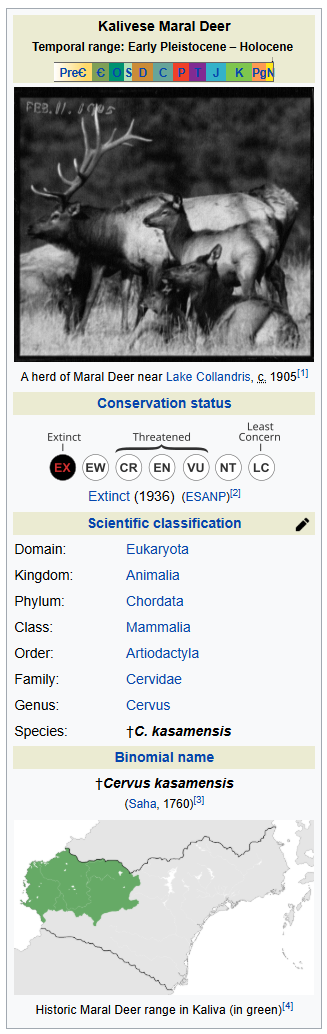
The Kalivese maral deer (Cervus kasamensis) also known as the maral or Kalivese elk, was a species of deer native to the Prinzish Highlands and Collandrian Basin. The last known of its species died in captivity at the Mjonsk Zoo in 1936 from what is believed to have been a prion infection.

Intensive hunting is generally considered to have been the main driver behind its extinction, per most Collandrian naturalists. However, other contributing factors to its demise also include the prevalence of infectious prion diseases, loss of habitat, and an uptick in pollution from the rise of copper, coal, iron, and lead mining in Western Kaliva. Since its extinction, there have been multiple alleged sightings of live maral in the wild, however, none have been confirmed or verified by scientists.
 
Hershy Lovenfeld

From Sepadiqiþan, the instant quotebook
l7bbih.png

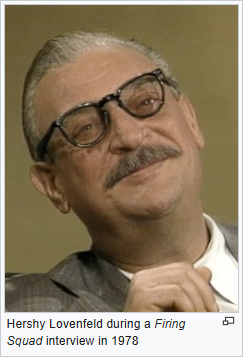
Herschel Paul Feldman (born June 23, 1924 – February 5, 2012), more popularly known by his stage name, Hershy Lovenfeld, was a Kalivese stand-up comedian, writer, producer, actor, and television host.

Quotes
I drink too much. The last time I gave a urine sample it had a lemon slice and pink umbrella in it.
- "Shut up, Kid!" Quotations from Hershy Lovenfeld, the man with a Mouth That Roars (1989)​
When I looked up my family tree, I found a yellow dog pissing on it.
- Uncommitted Comedian (1995)​

4pzrem.png
Sepadivjdje has an article about:​
Hershy Lovenfeld


Last edited:
Übel W. Sleipur IV

From Sepadivjdje, the instant encyclopedia

For other people named Übel W. Sleipur, see Übel W. Sleipur (disambiguation).

xa5dl7.png

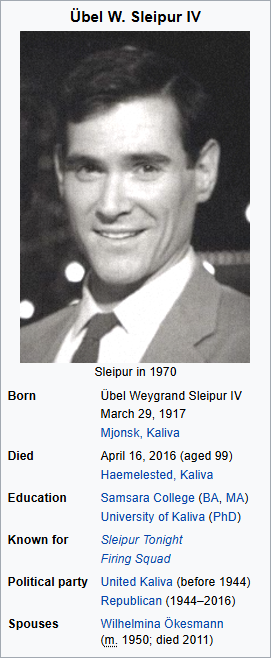
Übel Weygrand Sleipur IV (March 29, 1917 — April 16, 2016) was a Kalivese media personality, right-wing[1] political commentator, diplomat, and lobbyist. He created the political commentary series Firing Squad, which he hosted and produced from 1969 to 1982. He also hosted and produced Sleipur Tonight, which ran from 1982 to 2003.

Born in Mjonsk to petroleum geologist and businessman Übel W. Sleipur III, his first language was Predicean[2], having spent his childhood in Mezoraica. He served in the Royal Kalivese Army during the Fascist Wars as an intelligence officer and translator. After the war, he attended Samsara College, graduating with a degree in history.

He began his media career in 1957, working at the International Allied Press's Kalivese Bureau. In 1961, he was hired by KVSY-TV in Mjonsk as an investigative journalist, mainly covering local and municipal politics within the Greater Mjonsk region. From 1969 to 1982, he hosted Firing Squad, which thrust him into national fame for his sharp wit and unique debating style.
 
Last edited:
Firing Squad (TV program)

From Sepadivjdje, the instant encyclopedia

vw9amd.png

Firing Squad
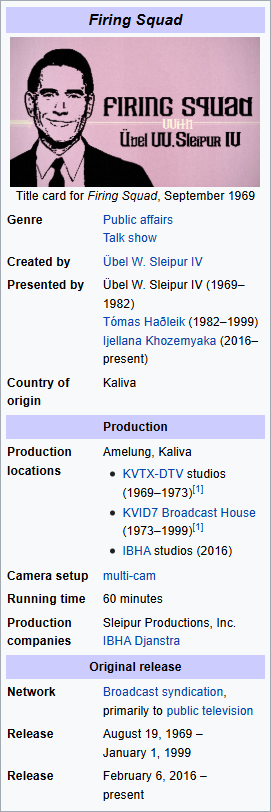
is a Kalivese public affairs television show. It first ran from 1969 to 1999, hosted by Übel W. Sleipur IV from 1969 to 1982 and Tómas Haðleik from 1982 to 1999. A revival was launched in 2016, with columnist Ijellana Khozemyaka as the new host.

The show was lauded for featuring countless influential political and cultural figures from Kaliva, and later, Eras as a whole. Firing Squad was additionally noted for its ability to field an ideologically diverse collection of guests, many of whom often held views that sharply contrasted with those of the host.

In 1979, the show won an International Noden Award for television journalism.
 
Bernadotte von Kreichaff

From Sepadivjdje, the instant encyclopedia

bzuy7g.png

Bernadotte Långspjut Ellujazker Waladamēr von Kreichaff (20 October 1898 – 22 June 1951) was a Getidaxan politician, industrial engineer, industrial statistician, writer, and dictator of Getidaxa from 1930 to 1949, leading the nation into the Collandrian Fascist Wars as a member of the Dominion. Von Kreichaff first rose to power as Secretariat of the Synarcho-Nationalist Party prior to his appointment as Prime Minister, and per historians, is ideologically considered to sit between radical fascism and authoritarian national syndicalism.

He was born in Pataliputra, Syrixia, as his father, Dr. Reinhart von Kreichaff, was working in the country as a physicist studying radioactive elements, namely the element Thorium, which had, at the time, been mined in the Collandean Orogeny for usage in ceramics and the manufacture of carbon arc lights. The von Kreichaff family would later return to Getidaxa while Bernadotte was five years old, largely due to the degradation of his father's relationship with his professors and academic life as a whole. While Bernadotte was young, his father had given up on working entirely after his failure to move from traditional physics into theoretical physics, believing that non-theoretically physics wasn't prestigious enough of a career. From 1903 to about 1907, the entire family was on-paper stateless due to Reinhart's failure to renew his Getidaxan citizenship after the expiration of their Syrixian visa.

In 1915, Bernadotte enlisted in the Royal Army of Getidaxa during the Collandrian War, becoming a quartermaster officer. During the war, he was said to have been 'highly skilled' at accountancy and assisted in coordinating military rail transport. He was forced out of active service following a gas attack which permanently damaged his lungs, having earned the Medal of Ragnarøkkr and Medal of Valour for his service. From 1917 to 1920, he attended the University of Ānandasattva in Kaliva from 1917 to 1920 and graduated with an engineering degree, where he became an industrial engineer and one of the first supply chain analysts and management consultants, founding the firm Kreichaff-Langweil alongside architect and urban planner, Alexandros Langweil-Reichsgraf.

He grew disillusioned with the politics of the ruling Konservatie Party of Getidaxa, especially after the aftermath of the Collandrian War. Per both personal writings and public statement, he believed then-Prime Minister Klaudios Brailoveski to be nothing more than a 'lukewarm liberal' in his eyes. He would join the then-fringe and ideologically isolated People's Synarcho-Nationalist Party in 1922, having been previously aligned to the Getidaxan Communist Party, like his father. As a member, he found success as a columnist for the party's newspaper, writing nationalistic essays and condemnations of the country's ruling class. By 1924, he found himself named Secretariat of the Party, where he used his logistical knowledge to begin the construction of a brutal and efficient political machine and party apparatus, which enabled the Synarcho-Nationalists to win a handful of seats in Parliament in the 1925 election.

When a severe economic downturn struck the nation in 1928, his political apparatus struck quick, inundating the populace with anti-Engivatten and pro-Synarcho-Nationalist propaganda, enabling them to emerge as the largest party in parliament in the succeeding election. Bernadotte von Kreichaff was appointed Prime Minister, serving extra-parliamentarily before consolidating power as dictator through purges, political repression, and censorship of the opposition. Serving to enforce his rule was the Getidaxan Synarchist Brigade, a secret police colloquially referred to as "the Orange Berets," who were known to assault, assassinate, and disappear those deemed "social or political threats" to the regime. Through executions and other repressive tactics, it is believed that he is responsible for somewhere between 50 thousand to 200 thousand civilian deaths during the Orange Terror.

As dictator, he manufactured a cult of personality to solidify his rule, and oversaw Getidaxan land redistribution, agricultural collectivization, and mass industrialization via the Ray of Light Campaign. The Ray of Light Campaign was brutally enforced through the institution of labor camps and forced relocations; mass execution, abuse, and torture, were prevalent in these conditions. His push for Getidaxan militarization and nationalist foreign policy would culminate into Getidaxa's entry into the Collandrian Fascist Wars. Aligning with Maloria and Dorivera, he declared war on Syrixia, Kaliva, and Senasahasran. As the tide of war turned against the Dominion and the war's outcome became evident, von Kreichaff attempted to flee abroad as Kaiser Emil II abdicated; it is believed by historians his intended destination was to Maloria. However, he was detained by Doriveran forces, who used his extradition as leverage in negotiations with the Allied powers, culminating in his deportation back to Getidaxa. After deportation, he was put on trial by the Allies during the Collandrian Tribunals, where he was convicted on all counts for crimes against humanity, crimes against peace, and war crimes. He requested a traditional execution of being burned alive; this request was summarily died and he was instead executed via hanging on June 22, 1951.

In contemporary scholarship, he is regarded as a totalitarian, war-mongering dictator responsible for countless deaths and who oversaw various crimes against humanity during his regime. Under both the Transitional Allied Administration of Getidaxa, and the later premiership of Paul Vuoddavuohti, a significant de-Kreichaffication campaign was undertaken to destroy the remnants of his cult of personality and regime.

 
Blīþnahll of Brūkyr

From Sepadiqiþan, the instant quotebook

8cov6v.jpeg

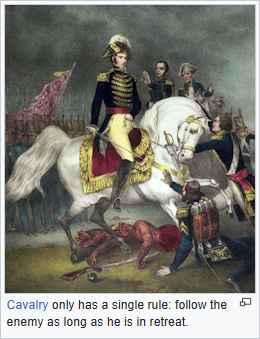
Gustave Kyrenstad Blīþnahll (born December 22, 1777 – May 10 or 11, 1816), was a Getidaxan military and revolutionary leader during the Wars of the Callisean Republic.

Quotes
War's arrival has yet to come, but it will come and at that soon; and when it does come, my advice is to draw the sword and throw away the scabbard.
- Speech to cadets in Aþalsreiks (1809)​
Cavalry only has a single rule: follow the enemy as long as he is in retreat.
- Statement to General Ioannes (May 5, 1812); as quoted in Long Way to Kaliva (1839) by Dumézil Acharya
We are all leaders of the Gettican People's Revolutionary Liberation Army. If you see a Papalide, kill him. If you see a Dæon, go on your way, for he knows not what he is.
- Speech to troops (1813); as attested in Shattering of the Crowned Lands (1865) by Andreas J. Lacanne, vol II, p.127​
Gots can be killed, but never conquered.
- Said to an enfant-de-troupe (1815); as attested in Shattering of the Crowned Lands (1865) by Andreas J. Lacanne, vol III, p.452​

Misattributed and/or dubious
The so-called Emperors of Syrixia and Ceretis mean nothing to me. Pataliputra and Sion are nothing but a den of vipers and thieves. I shall rout them out!
- Reputedly from a meeting of the Provisional Congress of Free Collandria (1811). Similar quotes have been dubiously attributed to both Baron Von Anheuser, "The den of vipers and thieves, known to us as Pataliputra and Sion," (1806) and to Getidaxan Consul, Finnr Gulrkon van der Schütze, "Pataliputra and Sion are cities of vipers and thieves, with the most voracious viper sitting on a throne" (undated, allegedly from between 1832-4, during the Coral Sea Campaign.)​
Suavidici, what can one say of them aside from being a state who cares only to invoke the past thousand years. We shall invoke the next thousand!
- There is no known basis to attribute this saying to Blīþnahll. It is found (unattributed) in online forums and blogs, starting from 1995.​


4pzrem.png
Sepadivjdje has an article about:​
Blīþnahll of Brūkyr


Last edited:
Back
Top